
Is Modi Still the Favorite Amid Gen Z Protests in India? What the Polls Say
Is Modi still the favorite as Gen Z protests grow? What the protests are about, what the polls say, and the doubts raised about the poll itself.
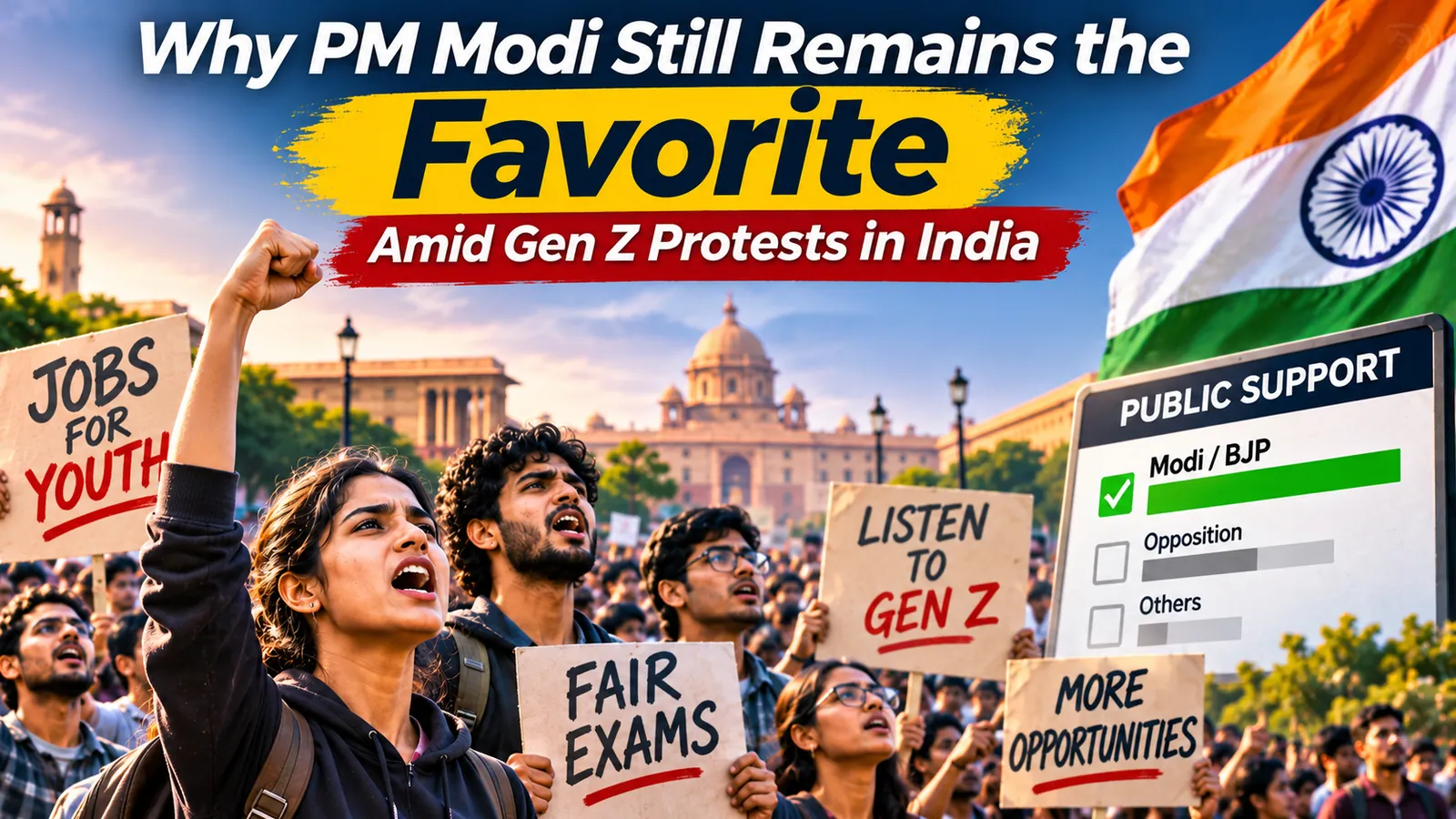
India’s streets have not been this restless in years. Young people, many of them in their twenties, have filled public squares in New Delhi and other cities in a wave of protests that began in the summer of 2026. They are angry about jobs, leaked exam papers, and a feeling that the system does not listen to them. Some commentators have compared the mood to youth-led uprisings in neighboring countries.
And yet, if you look at the latest opinion polls, Prime Minister Narendra Modi is still the most popular national leader in India by a wide margin. This article explains what the protests are about, what the numbers say, and why many analysts believe his position is dented but not broken.
What are the Gen Z protests in India about?
The movement did not start with a political party. It began online. In May, after India’s chief justice made a remark comparing unemployed people to “cockroaches,” a young political communications specialist launched a satirical online group called the Cockroach Janta Party, which called itself the voice of the lazy and unemployed. According to a TIME opinion column, the first protest took place at Jantar Mantar in New Delhi on June 6, and the group’s social media following grew explosively within days.
Several grievances came together. A leak in a major medical entrance exam, taken by more than 2.2 million students, led to the test being canceled and retaken in June. Graduate unemployment is a long-running worry: an Azim Premji University report cited by Reuters found that nearly 40 percent of graduates aged 15 to 25 are jobless. Official figures put unemployment among people aged 15 to 29 at 9.9 percent in 2025, compared with a little over 5 percent for the whole country.
By autumn the demands had widened. Reuters reported in October that protesters were also calling for the head of the Election Commission to resign over a revision of voter lists that activists and opposition parties say favors the ruling party. The commission, the government, and the BJP deny that claim. Police detained protesters in large numbers, and the Armed Conflict Location and Event Data Project, a research group, said street protests in India this year are likely to be higher than in any year of the past decade.
How the government has responded
The response has been a mix of concessions and force. The exam at the center of the anger was canceled and rerun, and, according to the TIME column, the education minister resigned under pressure. At the same time, police cleared protest sites, used batons and tear gas on marchers heading toward Parliament in July, and detained many demonstrators. Police say they followed proper procedures. The government has also pointed to its own jobs data, which says the economy created 168.3 million jobs in the six years to 2024.
The polls: dented, not defeated
The most useful snapshot comes from the India Today–CVoter Mood of the Nation survey, conducted between July 1 and August 25, 2026. It shows Mr. Modi slipping, but staying far ahead.
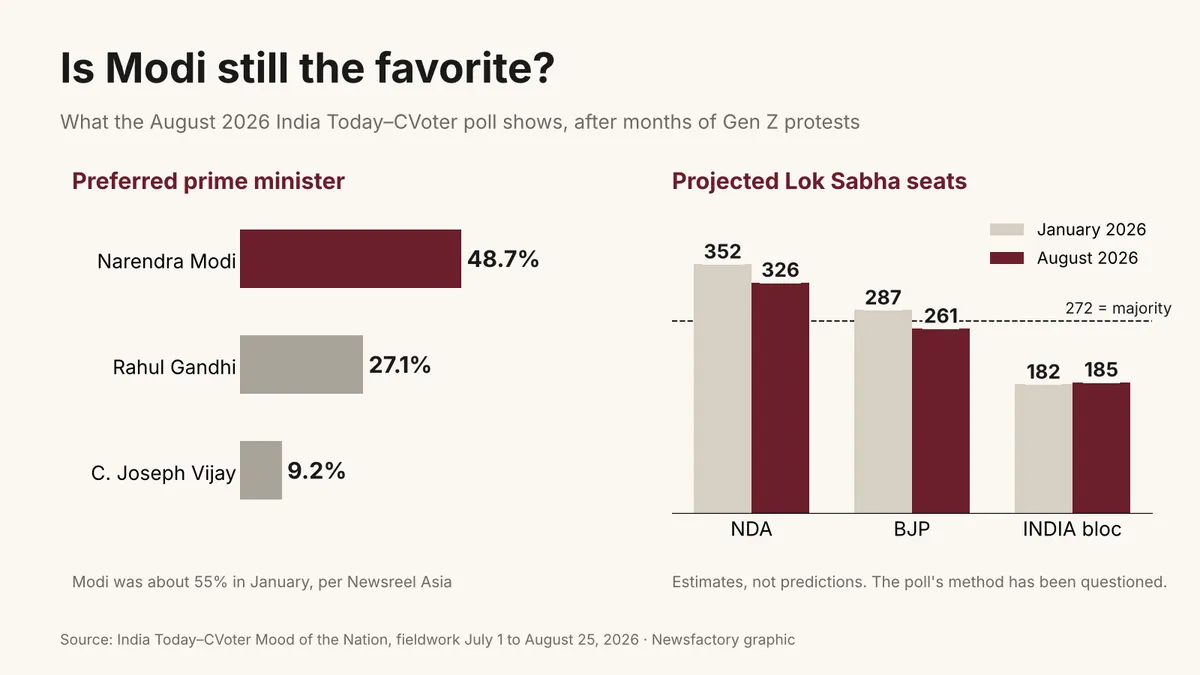
- Preferred prime minister: Mr. Modi was the top choice at 48.7 percent. Opposition leader Rahul Gandhi was second at 27.1 percent, and actor-turned-politician C. Joseph Vijay was third at 9.2 percent. That is down from about 55 percent in January, according to Newsreel Asia's reading of the earlier poll.
- Seats: The survey projected the ruling National Democratic Alliance (NDA) at 326 seats if an election were held now, down from 352 in January but still comfortably above the 272 needed for a majority. The opposition INDIA bloc was projected at 185 seats.
- The BJP on its own: It was projected at 261 seats, a drop of 26 from January, though still above the 240 it won in 2024.
A separate global tracker, Morning Consult, ranked Mr. Modi first among world leaders in March 2026 with a 68 percent approval rating, as widely reported in Indian media. That was before the protests grew, and its online method differs from Indian phone surveys, so the figures are not directly comparable with the poll above.
Questions about the poll
The survey has also drawn criticism, and it is fair to weigh it. Political analyst Yogendra Yadav, writing in National Herald, and the news site Newsreel Asia both point out that the results combine several sets of interviews collected over different periods: about 25,000 new interviews from July 1 to August 25, plus about 92,000 from the pollster's regular tracker over the previous months. They say most of the answers were gathered before the protests were in full swing, that the reported sample total does not match its two parts, and that it is not explained how the samples were combined. Critics have asked for results based only on the newest interviews. Mr. Yadav does not accuse the pollster of deliberately inflating the numbers, but argues the method should have been made clear and that the BJP's strength may be overstated. Treat the seat projections as estimates, not predictions.
What young people told pollsters
The same pollster ran a smaller survey of 1,270 people aged 18 to 35. The results explain the street anger. More than 80 percent said they feel weighed down by worry about an uncertain future, and 70 percent called unemployment serious. Sixty-seven percent said government exams are not run fairly, and 67 percent said they sympathize with the Jantar Mantar protests. Among the wider sample of more than 116,000 adults, 47 percent said democracy is under threat, compared with 42 percent who disagreed, and 56 percent said the government’s economic policies mainly help big business.
Interestingly, the young respondents were split on what to do next: 42 percent wanted the Cockroach Janta Party to stay a pressure group, while 40 percent said they would vote for it if it became a political party.
Why Mr. Modi still remains the favorite
Put together, the evidence points to several reasons. These are interpretations based on the polls and on what analysts have said, not certainties.
- No clear alternative yet. Mr. Modi leads Rahul Gandhi by more than 20 points on the question of who should be prime minister. Analysts quoted by Reuters and TIME describe the opposition as fragmented, which makes it hard for any single challenger to turn anger into a winning coalition.
- Protest is not the same as a vote. People under 30 make up nearly a quarter of India’s roughly one billion voters. That is a big bloc, but it is not a majority, and sympathy for protesters does not automatically mean a vote against the ruling party. Rahul Verma of the Centre for Policy Research told Reuters it is too early to say what the electoral effect will be.
- A strong party machine. The BJP’s organization and its record of winning elections remain a major advantage. The party credits its wins to Mr. Modi’s popularity and the economy, and the TIME column itself notes that the protests pose no immediate threat to the government because of the party’s dominance.
- Time is on his side. The next general election is not due until 2029. Even the most critical analysts describe this as his toughest period since 2014, yet the government remains stable.
The risks for the government
None of this means the protests are harmless. The slide in seat projections and in Mr. Modi's preferred-prime-minister score suggests that the movement may be costing support, though the polls cannot prove the cause. Mr. Modi’s image as a strong leader has also been mocked in satire, according to the TIME column. Critics point to concerns about press freedom and democratic standards, while the government rejects those claims.
The next real test may come sooner than 2029. Reuters notes that the Uttar Pradesh state election early next year could show whether youth anger is turning into votes. Uttar Pradesh is India’s most populous state, so the result will be watched closely.
The bottom line
India’s young people are telling their leaders, loudly, that jobs and fair exams matter more than slogans. Mr. Modi remains the clear favorite today because the alternatives are weaker, his party is strong, and the next national election is still years away. But the numbers are moving in the wrong direction for him, and how the government handles jobs, exams, and protest rights over the next few months will decide whether that slide continues.
Sources: Reuters analysis (via TimesLive, October 16, 2026); TIME opinion column by Asim Ali (August 1, 2026); India Today–CVoter Mood of the Nation (as reported by Business Today, The Wire and Supreme News Network); criticism of the poll by Yogendra Yadav (National Herald) and Newsreel Asia; Morning Consult approval ranking (as reported by All India Radio and others); Wikipedia timelines of the 2026 Jantar Mantar protests and the NEET-UG 2026 exam scandal. Poll figures are survey estimates, not election results.
Newsfactory articles are written for general information and are not financial, legal or investment advice. See our disclaimer and editorial policy.