

Grand Theft Auto VI: The Game That Became a Global Entertainment Empire
Explore the history of Grand Theft Auto, Rockstar Games, the origins of GTA, GTA VI's story, launch price, record sales, cultural impact and the future of the franchise.
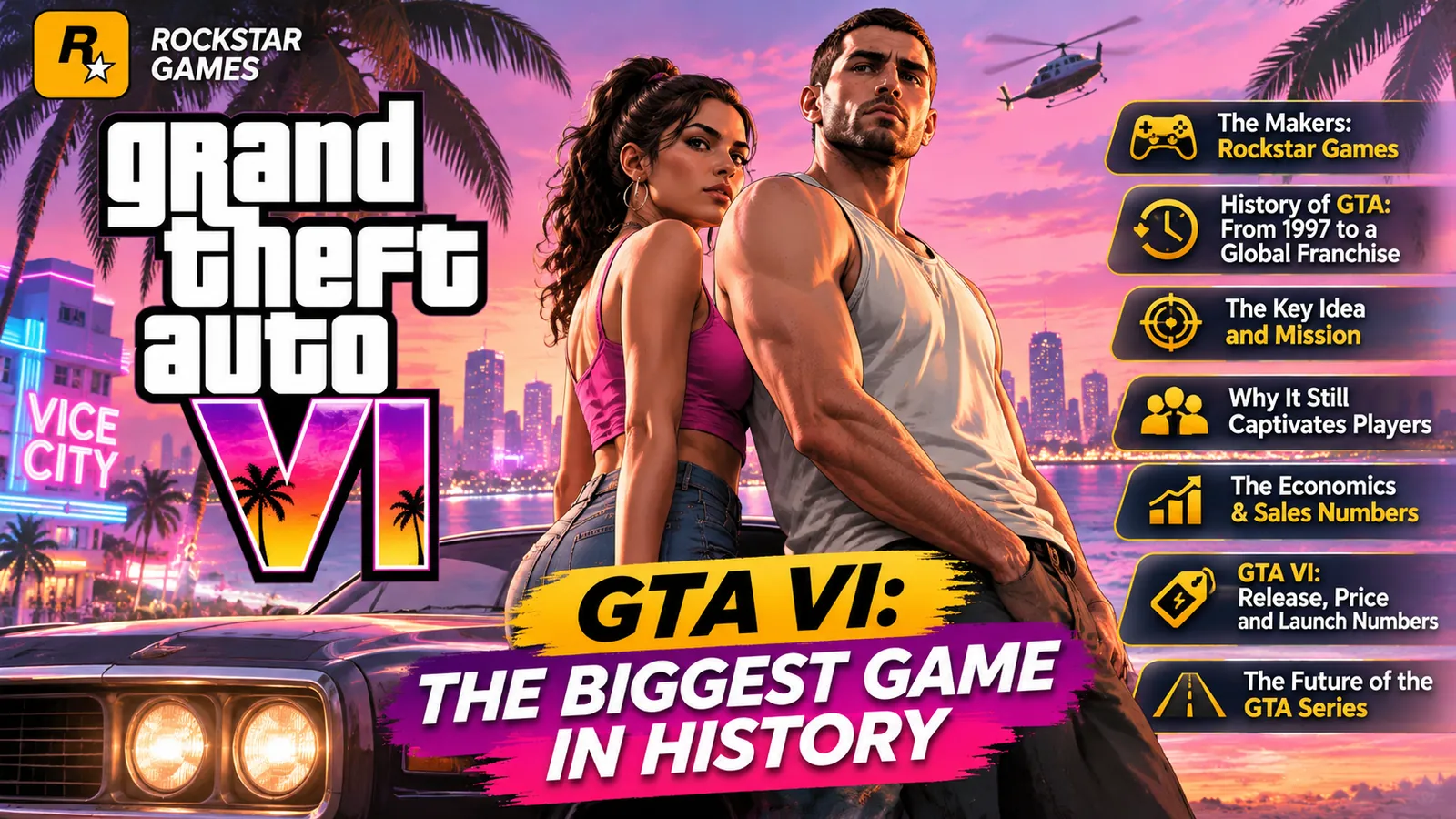
From a small Scottish studio's experimental driving game to a multi-billion-dollar entertainment phenomenon, the Grand Theft Auto franchise has transformed video gaming. Now, with Grand Theft Auto VI released, Rockstar Games has entered the biggest chapter in the series' history.
Introduction: More than just a video game
Known worldwide as GTA, the series has evolved from a relatively simple top-down driving game into an expansive entertainment experience built around fictional cities, complex characters, open-world exploration and social satire.
The latest instalment, Grand Theft Auto VI (GTA VI), arrived on 19 November 2026. Its launch has already produced extraordinary commercial figures. According to its parent company, Take-Two Interactive, the game generated an estimated $3.79 billion in worldwide retail sales on its first day.
But GTA's importance cannot be measured only in sales. Over nearly three decades, it has influenced game design, popular culture, music, digital entertainment and the business strategies of major publishers. Its success also raises questions about the relationship between mature entertainment, younger audiences and the responsibilities of parents and the gaming industry.
Rockstar Games: The company behind the phenomenon
Rockstar Games is the publisher and creative force most closely associated with the modern GTA franchise. Founded in 1998, it is a wholly owned subsidiary of American video-game company Take-Two Interactive.
The company was established by a group that included Sam Houser, Dan Houser, Terry Donovan, Jamie King and Gary Foreman. Sam Houser became one of the most recognisable figures behind Rockstar's identity and its approach to ambitious, story-driven games.
Rockstar's reputation has been built on detailed virtual environments, distinctive characters, cinematic storytelling and a willingness to explore controversial themes. Its other major franchise, Red Dead Redemption, demonstrated that the company's approach could work beyond contemporary crime stories.
There is, however, an important distinction in GTA's history: Rockstar did not create the original Grand Theft Auto in its current form. The first game was developed by DMA Design, a Scottish studio based in Dundee. Rockstar's connection to the original development team grew through the evolution of the company and its acquisition of DMA Design, later known as Rockstar North.
Rockstar's corporate history identifies the company's 1998 founding and its relationship with Take-Two Interactive.
The beginning: How the first GTA was born
The story began in the mid-1990s, when DMA Design was working on a project with the title Race'n'Chase.
The original concept was a city-based driving game built around the familiar idea of cops and criminals. Players would move through a simulated urban environment, drive vehicles and interact with a city that responded to their actions.
The development team wanted to create a world that felt active rather than a simple sequence of disconnected racing tracks. The city, traffic, pedestrians and police response were intended to contribute to the experience.
The project evolved through experimentation. According to accounts from the original developers, the team discovered that the criminal role and the freedom to move through the city offered a more engaging experience than the initial straightforward police-versus-criminal racing concept.
That shift helped shape the identity of Grand Theft Auto.
The original game was released in 1997, developed by DMA Design and published by BMG Interactive. It used a top-down camera perspective and allowed players to explore three fictional American cities: Liberty City, Vice City and San Andreas.
The graphics and technology were modest by today's standards. Yet the central idea was ambitious: give players a city, a character, a set of objectives and considerable freedom in deciding how to move through the game world.
The original concept established the foundation for everything that followed.
The evolution: From a top-down game to a global franchise
The series changed dramatically with the arrival of Grand Theft Auto III in 2001. The move to a fully three-dimensional city transformed the way players experienced the fictional world.
Instead of looking down at a map-like environment, players could explore streets and buildings from a third-person perspective. The city became more immersive, and the relationship between missions and free exploration became a defining feature.
The franchise continued to grow through several landmark releases:
Grand Theft Auto: Vice City (2002): Introduced a colourful fictional version of 1980s Miami, with a strong identity built around music, fashion and atmosphere.
Grand Theft Auto: San Andreas (2004): Expanded the scale of the game world and introduced a broad range of activities and character-development features.
Grand Theft Auto IV (2008): Presented a more grounded story and a detailed version of Liberty City.
Grand Theft Auto V (2013): Introduced three playable protagonists and a large open world that supported both a story campaign and the continuing GTA Online experience.
Grand Theft Auto VI (2026): Returns to Vice City in a modern setting, expanding the series into its latest generation.
The release gap between GTA V and GTA VI has been particularly significant. GTA V arrived in 2013, while its successor took 13 years to reach players. That long interval became part of the anticipation surrounding the new game.
The mission and the world of GTA VI
GTA VI is set in the fictional state of Leonida, with Vice City serving as its central urban setting. The game follows two main characters, Jason and Lucia.
Rockstar's official story description presents them as people whose circumstances lead them into a criminal conspiracy. When an attempted easy opportunity goes wrong, they find themselves relying on each other as events unfold across Leonida.
The central narrative continues the franchise's established themes: ambition, money, crime, loyalty, power and the contradictions of modern American life.
The word "mission" has two meanings in the GTA universe. Within the game, missions move the story forward through objectives and character interactions. At a broader design level, the series has aimed to create a world in which players can explore beyond the main storyline.
That combination of structured storytelling and open-ended exploration is one of the franchise's most recognisable features.
GTA VI is a single-player experience at launch. Its confirmed launch platforms are PlayStation 5 and Xbox Series X|S.
Why does GTA continue to attract attention from teenagers and adults?
GTA's appeal extends across generations. Adults who played earlier versions have followed the series for years, while younger audiences have encountered it through online conversations, gaming culture, video commentary and the wider popularity of the franchise.
Several factors help explain its cultural reach.
A world that feels alive
GTA games are known for their detailed cities. Streets, vehicles, pedestrians, businesses, radio stations and changing environments contribute to the impression that the game world continues to exist beyond the immediate mission.
Freedom and player choice
Traditional games often move players through a fixed sequence of levels. GTA's open-world structure offers more freedom to explore, travel and interact with the environment.
Satire and cultural references
The franchise uses fictional cities and exaggerated characters to comment on consumerism, celebrity culture, politics, advertising and social behaviour.
Music and nostalgia
Music has always played an important role in GTA. Radio stations help establish the atmosphere of each fictional city and connect different generations of players to particular musical eras.
A major place in gaming culture
GTA has become a regular subject of online discussion, criticism, entertainment coverage and gaming commentary. The long wait for GTA VI intensified that attention, making its release a major cultural event.
An important age-rating distinction: GTA is mature-rated entertainment. GTA VI carries an ESRB Mature 17+ rating, with content descriptors including intense violence, strong language, nudity, sexual content and drug and alcohol references. It is not designed for younger children or teenagers. The game's popularity among younger audiences should not be confused with an age recommendation.
The discussion around GTA is therefore not simply about why it is entertaining. It is also about age ratings, parental guidance and how mature media is encountered in a digital culture where clips and commentary can circulate widely.
The economics of GTA: A business bigger than gaming
GTA is not just a successful entertainment property. It is one of the most valuable franchises in the video-game industry.
Its commercial model extends beyond the sale of individual games. It includes long-term player engagement, digital content, online services, subscriptions and the wider value of the Rockstar brand.
Take-Two Interactive reported that the Grand Theft Auto franchise had sold nearly 480 million units worldwide in its November 2026 announcement. The same announcement said GTA V alone had sold nearly 235 million units.
Those figures demonstrate the extraordinary longevity of a franchise whose most recent mainline release before GTA VI was launched in 2013.
The numbers behind the franchise
| Measure | Reported figure |
|---|---|
| First Grand Theft Auto release | 1997 |
| Rockstar Games founded | 1998 |
| Grand Theft Auto III release | 2001 |
| Grand Theft Auto V release | 2013 |
| Grand Theft Auto VI release | 19 November 2026 |
| GTA V worldwide sales | Nearly 235 million units |
| GTA franchise worldwide sales | Nearly 480 million units |
| GTA VI first-day retail sales | $3.79 billion, company estimate |
The sales figures above are based on Take-Two's published statements and should be understood in the context of the reporting dates.
GTA VI's extraordinary launch
The financial scale of GTA VI became clear immediately after launch.
On 20 November 2026, Take-Two announced that GTA VI had generated an estimated $3.79 billion in worldwide retail sales on its first day. The company described it as the biggest entertainment launch in history.
Take-Two also reported 32.5 million units sold before release. That is a company-reported figure, and it should not be confused with a separately audited lifetime sales total.
The distinction between retail sales, publisher revenue and profit is important. Retail sales represent the value of purchases at the consumer level; they do not mean that the entire amount becomes Rockstar's or Take-Two's profit. Retailer shares, platform fees, taxes, distribution costs, marketing and development expenses all affect the final financial result.
What about the game's development cost?
There has been widespread speculation about how much GTA VI cost to make. However, Rockstar and Take-Two have not published a definitive total production budget in the sources cited here.
For that reason, estimates circulating in media reports should not be presented as confirmed company figures. A large commercial launch does not, by itself, reveal the game's development cost or profit margin.
GTA VI: Latest release, editions and pricing
As of 26 November 2026, Grand Theft Auto VI is available worldwide.
Rockstar's launch announcement confirms availability for PlayStation 5 and Xbox Series X|S. The company has not confirmed a PC edition in the launch information cited for this article.
| Edition | US launch price | What it includes |
|---|---|---|
| Standard Edition | $79.99 | The base game |
| Ultimate Edition | $99.99 | The game plus additional digital content |
The Ultimate Edition includes additional in-game items such as vehicles, clothing, weapon variants and other content associated with Jason and Lucia's story.
These are US launch prices, not universal prices. Local pricing, taxes, currency conversion and retailer policies can differ by country. The prices should not be converted into a fixed Indian retail price without checking an official India-specific listing.
Rockstar's customer-support information also confirms that the physical version is supplied with a download code inside the box rather than a traditional game disc. This is a notable change for buyers who associate physical game purchases with having a disc.
The future of the legendary GTA series
GTA VI has arrived after one of the longest gaps between major entries in the franchise. Its launch success gives Take-Two and Rockstar a powerful commercial foundation, but the future of the series will depend on more than its first-day sales.
The immediate priority is likely to be the continued support of the new game, including technical improvements and the development of its wider entertainment ecosystem. However, Rockstar has not officially announced a release date, title or development schedule for a future mainline game such as GTA VII.
The franchise's history suggests that its fictional cities and characters have considerable room for further stories. Vice City, Liberty City and San Andreas have all become recognisable settings, while the series' central themes can be adapted to changing social and technological environments.
Future developments may also reflect changes in gaming technology. More powerful hardware, artificial intelligence, online services and increasingly detailed virtual environments could influence how large open-world games are designed.
Those are possibilities for the wider industry, not confirmed features or promises about the next GTA instalment.
Final verdict: A franchise that changed the business of entertainment
Grand Theft Auto began as an experimental driving game created by a small Scottish development team. Its original concept was far removed from the enormous, detailed worlds that define the modern series.
The transition from Race'n'Chase to Grand Theft Auto, the arrival of GTA III's three-dimensional world and the extraordinary success of GTA V turned the franchise into a cultural and commercial institution.
GTA VI represents the latest chapter in that journey. Its first-day sales announcement shows the scale of global interest, while its return to Vice City demonstrates the continuing value of the series' fictional worlds.
Yet the franchise's future will not be determined by one launch-day record. Its long-term influence will depend on the quality of its storytelling, the worlds it creates, the way it evolves with technology and how responsibly mature entertainment is presented to different audiences.
For Rockstar Games, GTA VI is more than another sequel. It is the next major test of a franchise that has helped shape the modern video-game industry.
Sources consulted
- Rockstar Games – Corporate Information
- Rockstar Games – A Message from Rockstar Games
- The Guardian – How We Made Grand Theft Auto
- Le Monde – The Unlikely Story of How a Young Group of Scots Created GTA
- Academy of Interactive Arts & Sciences – Sam Houser
- Take-Two Interactive – Rockstar Games Announces Pre-Orders for Grand Theft Auto VI
- Rockstar Games – Grand Theft Auto VI Now Available
- Rockstar Games Support – GTA VI Platforms, Editions and Versions
- Take-Two Interactive – GTA VI First-Day Retail Sales Announcement
- Associated Press – GTA VI Sets Record with $3.79 Billion in First-Day Sales
Newsfactory articles are written for general information and are not financial, legal or investment advice. See our disclaimer and editorial policy.