

Sony PlayStation: PS5 vs PS5 Pro, Which Should You Buy?
PS5 vs PS5 Pro compared: current US prices, specs, PSSR upscaling and who should buy which, plus what the PS6 talk means for you.
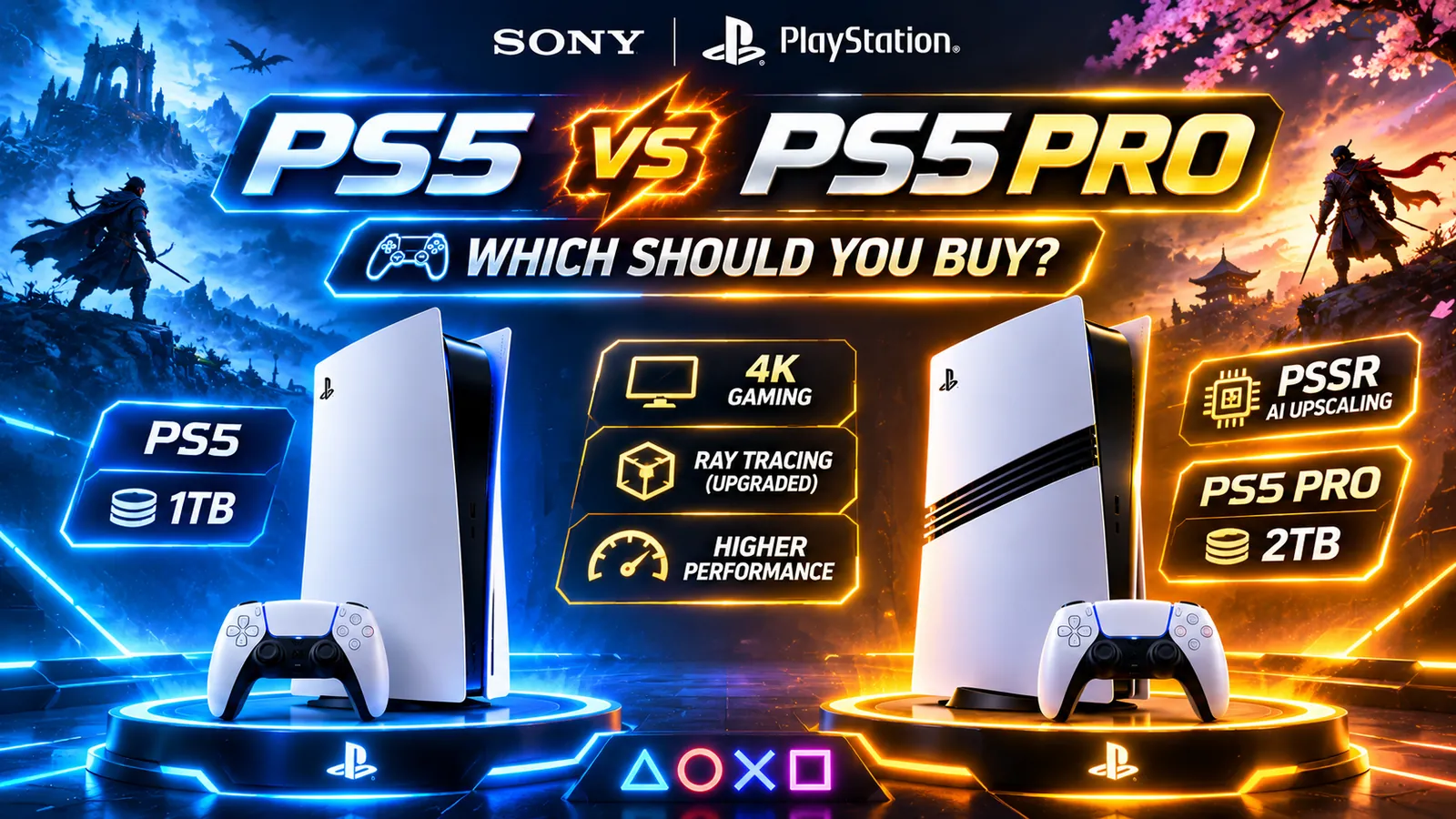
Sony raised console prices in the United States on April 2, 2026, and the gap between the regular PS5 and the PS5 Pro is now large enough that the choice really matters. The Pro costs $250 more than the standard disc model, and it does not even come with a disc drive.
So is the extra power worth it? This guide walks through current prices, the real hardware differences, what the Pro's upscaling does, and which kind of player should pick which console. We also look briefly at the PS6 talk, because some buyers wonder whether to wait.
What each console costs right now
Sony announced the latest price changes on the official PlayStation Blog on March 27, 2026, and they took effect on April 2. The reason Sony gave was continued pressure in the global economy. Several outlets also tied the broader trend to a shortage of memory chips, though that part is outside commentary rather than Sony's own wording.
Here are the recommended US prices after the change. Store prices can differ, and stock moves fast, so always check PlayStation Direct and big retailers before you pay.
| Model | US price | Disc drive | Storage |
|---|---|---|---|
| PS5 Slim (disc) | $649.99 | Included | 1TB |
| PS5 Slim (Digital Edition) | $599.99 | None (add-on available) | 1TB |
| PS5 Pro | $899.99 | None (add-on available) | 2TB |
For context, the Pro launched in November 2024 at $699.99, rose to $749.99 in August 2025, and now sits at $899.99. A separate disc drive costs roughly $80, so a Pro that plays discs lands near $980. That is a lot of money for a console.
Black Friday: do not count on a big discount
Last year Sony offered a $100 discount on a PS5 bundle for Black Friday. This year the picture is quieter. According to Push Square, Sony's announced Black Friday offers cover accessories, PlayStation Plus and games, but neither the standard PS5 nor the PS5 Pro is going on sale. Retailers set their own prices, so it is worth checking again before Black Friday on November 27. Still, plan for the possibility that you will pay the full price.
The hardware, side by side
Both consoles use the same basic recipe: an eight-core AMD Zen 2 processor, 16GB of fast GDDR6 memory, and a very quick custom SSD. The big changes in the Pro are the graphics chip, the extra memory for system tasks, the larger drive, and faster Wi-Fi.
The Pro's graphics processor has about 67 percent more compute units than the standard PS5, and Sony rates it at 16.7 teraflops compared with 10.28 for the regular console. Mark Cerny, the PlayStation system architect, has also said the Pro's ray tracing hardware is two to three times faster, which helps reflections look sharper and more natural.
| Spec | PS5 Slim | PS5 Pro |
|---|---|---|
| CPU | 8-core Zen 2 | 8-core Zen 2 |
| GPU power | 10.28 teraflops | 16.7 teraflops |
| Memory | 16GB GDDR6 | 16GB GDDR6 plus 2GB DDR5 |
| Storage | 1TB SSD | 2TB SSD |
| Wi-Fi | Wi-Fi 6 | Wi-Fi 7 |
| Ray tracing | Standard | Upgraded hardware |
| AI upscaling (PSSR) | No | Yes |
| Disc drive | Built in (disc model) | Sold separately |
| Size (W x H x D) | 14.1 x 3.8 x 8.5 in | 15.3 x 3.5 x 8.5 in |
| Weight | About 7.1 lb | About 6.8 lb |
One small note: the separate disc drive works with the Digital Edition and the Pro, and Sony sells it separately.
PSSR: the feature that makes the Pro different
PSSR stands for PlayStation Spectral Super Resolution. In plain terms, it is an artificial intelligence tool that draws a game at a lower internal resolution, then rebuilds it into a sharper picture. It works in a similar spirit to Nvidia's DLSS. The benefit is that a game can look crisp and still run smoothly, without forcing you to pick one or the other.
Sony has kept improving it. An upgraded version of PSSR (often called PSSR 2.0) arrived first in Resident Evil Requiem in February 2026, and Sony announced a wider rollout on March 16. Titles named at that time included Silent Hill f, Monster Hunter Wilds, Alan Wake 2, Control and Final Fantasy VII Rebirth, with others promised later. It is exclusive to the Pro. The standard PS5 cannot use it at all.
What it means for how games play
Most Pro-enhanced games offer a choice of modes. You might get a high-quality mode with better lighting and detail, or a smooth mode that aims for higher frame rates. On the standard PS5, those same games often ask you to trade one for the other more harshly. The Pro tends to narrow that trade.
If you own a 4K TV that supports 120Hz, the Pro is easier to justify, because it has more power to feed those faster refresh rates in the games that support them. On a 1080p TV or an older 4K set limited to 60Hz, you will notice less. As for 8K, the Pro supports it on paper, but almost no games or TVs make that a practical reason to buy.
Be careful with expectations. The Pro is not a new generation. It runs the same games, with the same controllers and the same online services. Many titles gain only modest improvements, and a smaller number gain a lot. Sony has not published one tidy count of Pro-enhanced games that we could verify, though the list has grown steadily since launch, when 55 titles were announced.
What both consoles share
Whichever you choose, you get the DualSense controller, the same game library, and the same PS Plus service. Both play the vast majority of PS4 games through backward compatibility. Both also work with the PlayStation VR2 headset, although VR2 is a niche purchase on top of everything else. Both have a slot for extra SSD storage, which matters because modern games are huge.
Who should buy which
The right answer depends on your TV, your budget and how you play. Here is a simple guide.
- Buy the PS5 Slim disc model if you want the cheapest way into PlayStation while still using physical games. At $649.99 it is the best all-round value, and it plays every PS5 game.
- Buy the Digital Edition if you only buy games online and want to save $50. You can add a disc drive later for about $80, but at that point the savings are mostly gone.
- Buy the PS5 Pro if you own a good 4K TV, ideally with 120Hz, and care about image quality and smooth performance. It also suits people who keep consoles for many years and want the strongest option available.
- Skip the Pro if you play on a basic TV, mostly play less demanding games, or would rather spend that $250 to $300 on games, a headset or a subscription.
- Think twice if you want discs on a Pro. The total cost with the drive is close to $980.
Value for money is where the debate gets sharp. The Pro is clearly the better machine, but it is not $250 better for most households. The standard model remains the sensible default, while the Pro is a premium treat for people who will see and feel the difference.
What about the PS6?
Sony has not announced a PS6 or given a launch date. Everything below is rumor and reporting, not confirmation. Earlier talk pointed to around 2027, but a Bloomberg report in February 2026, citing people familiar with Sony's thinking, said the company was considering 2028 or 2029 because of memory chip demand and costs. Sony has not confirmed that, either.
If those reports are right, the PS5 family will stay current for years. That is a point in favor of buying now rather than waiting. It also means a Pro bought today could have a long useful life. If you can happily wait, though, nothing suggests prices will fall sharply soon.
The bottom line
For most players, the standard PS5 Slim is the smarter buy: lower cost, a full game library and a built-in disc drive. The PS5 Pro is the right pick for people with a premium TV and a desire for the best possible picture, as long as they accept the $899.99 price and the extra cost of a drive. Check for last-minute Black Friday offers, compare stores, and buy the console that fits your screen and your wallet, not just the one with the bigger number.
Sources consulted
- PlayStation Blog: New Price Changes for PS5, PS5 Pro, and PlayStation Portal remote player (March 27, 2026)
- TechRadar: PS5 Pro vs PS5 comparison
- TechRadar: Sony's updated PSSR upscaling tech is available for more PS5 Pro games
- Tom's Hardware: PlayStation 5 Pro specifications explained by Mark Cerny
- Tom's Hardware: PS5 Pro confirmed, with a larger GPU and PSSR upscaling
- Push Square: Sony considering PS6 delay to 2028 or even 2029, report says
- Push Square: PS5 Black Friday sale
Newsfactory articles are written for general information and are not financial, legal or investment advice. See our disclaimer and editorial policy.