

How Much Do YouTubers Earn in 2026? Average YouTube Income Revealed
How much do YouTubers earn in 2026? Discover average YouTube income, RPM, CPM, earnings per million views, highest-paying niches and how creators make money.
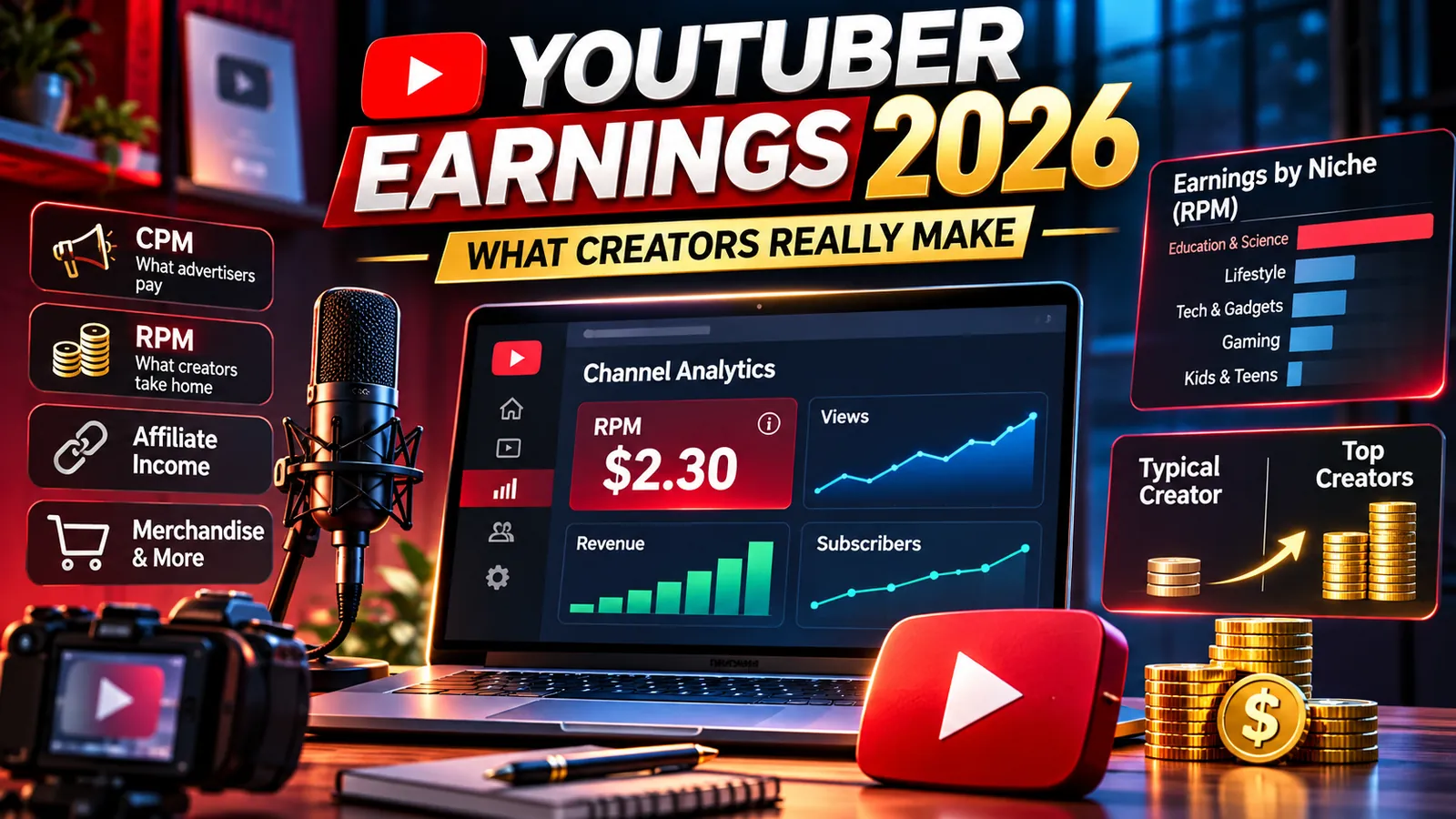
Have you ever wondered about how much really the youtubers earn? Are they earning millions? The reality for the typical YouTuber looks very different. YouTube does not publish an official average, so the numbers below come from the estimates gathered from various sources, which we label clearly. Together they show who earns what, why, and whether starting a channel still makes sense going into 2027.
1. Where your viewers live, the location matters most
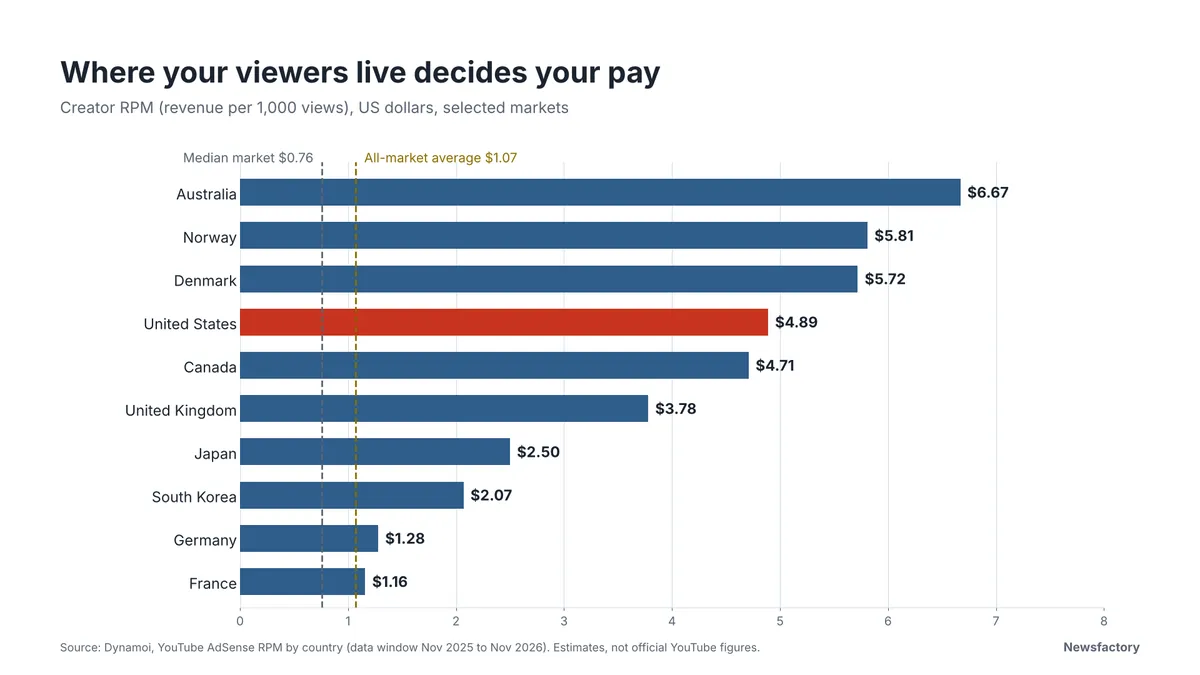
Advertisers pay far more to reach some countries than others. Dynamoi’s estimates put creator RPM, the money a creator earns per 1,000 views, at $4.89 in the United States and $6.67 in Australia, against an all-market average of $1.07 and a median market of just $0.76. By region, North America averages $4.86, Europe $1.52, the Middle East and Africa $0.90, Asia-Pacific $0.73, and Latin America $0.21.
AIR’s advertiser CPM data tells the same story: $14.67 in the US, $13.30 in Australia, and $12.98 in Switzerland, versus $0.74 in India and $0.53 in Pakistan and Bangladesh. Earnings also depend on YouTube’s supported countries, and monetization. The monetization is not available in some countries like Russia.
2. Age group viewership
Pew Research found in 2025 that 84 percent of US adults use YouTube, and it is one of only two platforms that a majority of adults in every age group use. In Pew’s 2024 figures, more than 90 percent of adults under 50 use it, 86 percent of people aged 50 to 64, and 65 percent of those 65 and older. About 33 percent of US adults use it several times a day or daily, with younger adults far more likely to do so. Among teens aged 13 to 17, 90 percent use YouTube and 73 percent use it daily.
These figures describe the United States only. They show that YouTube reaches every age group, with the youngest viewers the most active, but they do not show which age group generates the most money.
3. CPM: what advertisers pay
CPM is what advertisers pay for 1,000 ad impressions, before YouTube takes its cut. VidIQ’s estimates show how widely it varies by topic: $15 to $50 for personal finance, $20 to $50 for insurance, and $15 to $45 for legal content, against $2 to $8 for entertainment and vlogs and about $1 to $3 for music. These are estimates, not guarantees.
4. RPM: what creators actually take home
RPM is what a creator earns per 1,000 views after YouTube’s share. AIR and VidIQ both report that YouTube keeps 45 percent of long-form ad revenue and the creator keeps 55 percent. Not every view shows an ad, which is why RPM is lower than CPM.
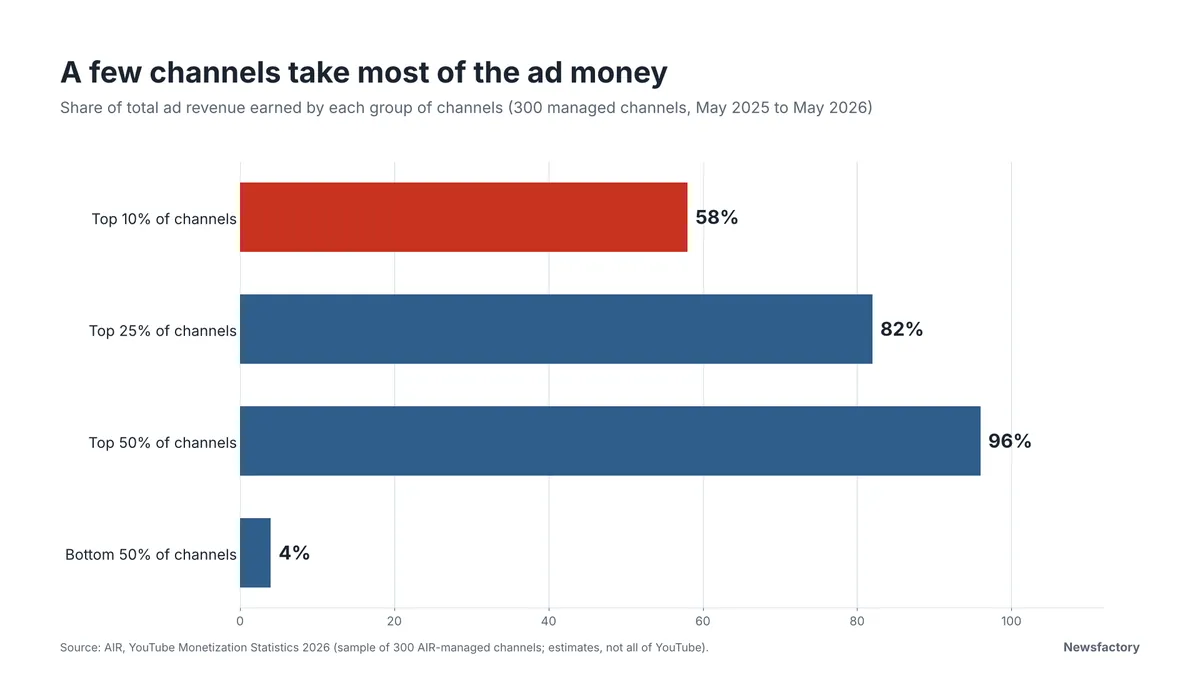
In AIR’s sample of 300 managed channels, the median RPM was $2.30, meaning the median channel earned roughly $2,300 per million long-form views. Only 53 percent of views showed an ad. Earnings are also very uneven: the top 10 percent of channels earned 58 percent of ad revenue, and the bottom half earned just 4 percent. This sample is not all of YouTube, so treat it as a guide.
5. Affiliate income
Many creators earn more from affiliate links than ads. VidIQ’s estimates say software affiliate programs often pay 20 to 40 percent recurring commissions, and a single brokerage sign-up may pay $50 to $200. It adds that for beauty and travel creators, affiliate income can match or beat ad revenue, and that a channel with 10,000 subscribers may earn more from affiliates than from ads with the right audience. YouTube also runs its own Shopping affiliate program for tagging products from other brands.
6. Merchandise and other income
YouTube’s Help pages list several other ways to earn: Shopping, which lets creators sell through their own store, channel memberships, Super Chat and Super Stickers, Super Thanks, and a share of YouTube Premium revenue. Under the expanded Partner Program, channels with 500 subscribers, three public uploads in 90 days, and either 3,000 watch hours in a year or 3 million Shorts views in 90 days can unlock fan funding and Shopping early. Memberships, Super Chat, and Super Thanks also require the creator to be 18 or older and in a supported country.
7. High-paying niches
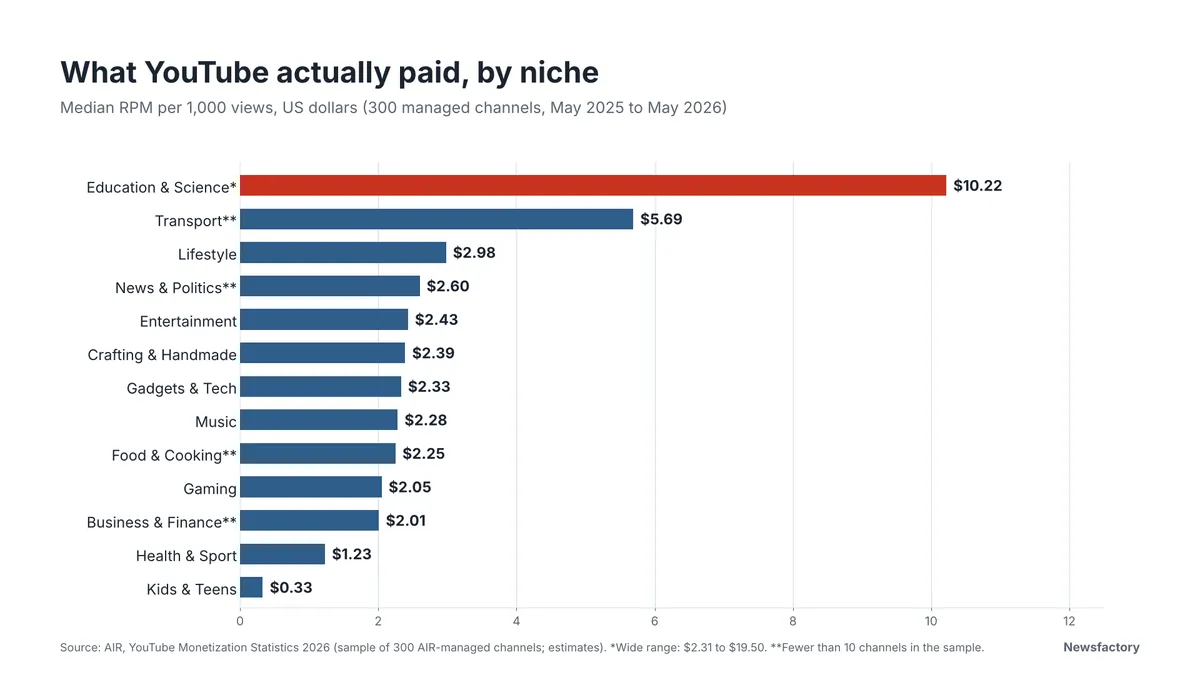
Money topics pay the best on paper. VidIQ’s estimates put CPMs at $15 to $40 for crypto and real estate, $10 to $30 for business software, and $10 to $25 for AI content. But what creators actually earned looks different. In AIR’s data, Education and Science had the highest median RPM at $10.22, while Lifestyle was $2.98, Gadgets and Tech $2.33, Gaming $2.05, and Kids and Teens just $0.33. The gap shows that a high CPM does not always become high pay, because not every view shows an ad.
8. AI-based content
AI can help a channel, but YouTube draws clear lines. Its monetization policy says content must be original and authentic, and AI-generated content built from generic templates that looks mass-produced is not allowed. AI used as a creative tool, such as editing scripts or generating a background visual, is fine if the final video shows the creator’s own vision. AI personas presenting as human experts on health, legal, finance, or political topics cannot be monetized.
Creators must also disclose realistic AI-made or altered content through the AI-use setting in YouTube Studio. Consistent failure to disclose can lead to penalties, including suspension from the Partner Program. YouTube says disclosure alone does not limit a video’s audience or its eligibility to earn money.
9. The highest-paid creators
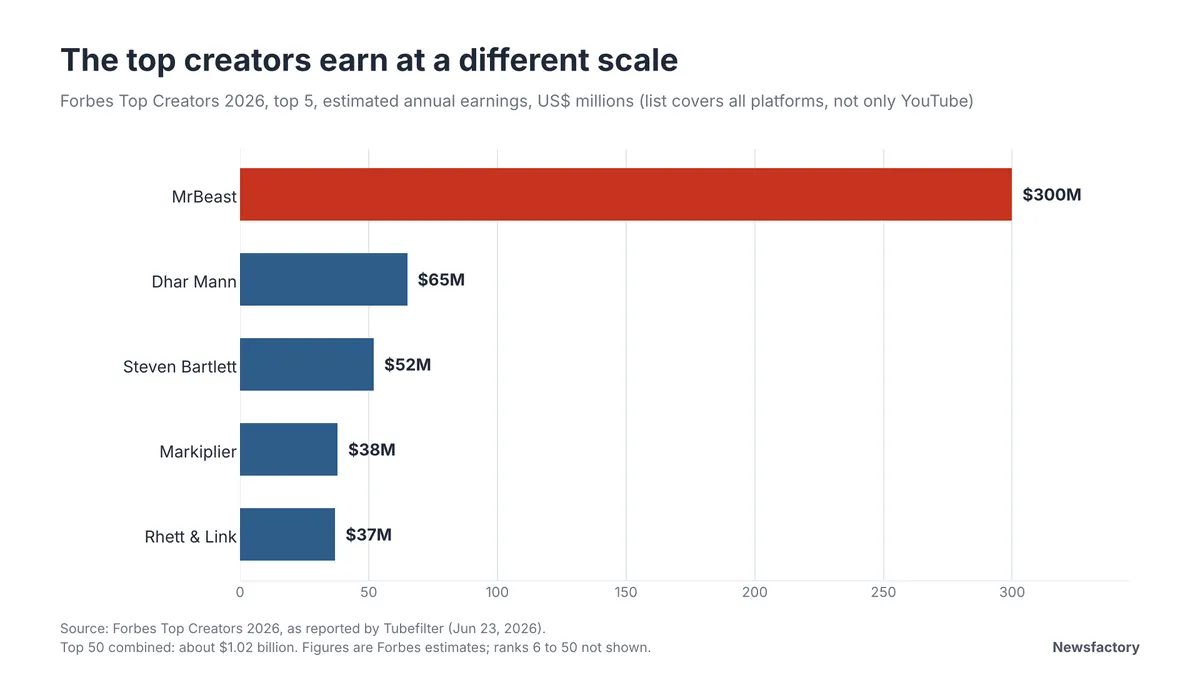
Forbes’ Top Creators 2026 list, as reported by Tubefilter, puts MrBeast first at an estimated $300 million, followed by Dhar Mann at $65 million, Steven Bartlett at $52 million, Markiplier at $38 million, and Rhett and Link at $37 million. The top 50 creators together earned about $1.02 billion, up 20 percent from $853 million in 2025. The list covers creators across platforms, not only YouTube, and the figures are Forbes’ estimates. By our calculation, MrBeast alone accounts for about 29 percent of that total.
10. Google’s policy on running ads
To earn from ads, a channel must join the YouTube Partner Program. The standard bar is 1,000 subscribers plus either 4,000 public watch hours in the last 12 months or 10 million Shorts views in 90 days, along with following monetization policies, having no active Community Guidelines strikes, and linking an AdSense account. Creators must be 18 or have an adult handling AdSense payments. Reviews typically take about a month, and a rejected channel can appeal within 21 days or reapply after 30 days.
Content must also meet YouTube’s advertiser-friendly guidelines. Videos fall into three tiers: can earn ad revenue, limited ad earnings, or no ad earnings. Creators can request a human review of automated decisions. Earnings can be withheld or charged back for violations such as invalid traffic or fake engagement, and payments may be delayed up to 90 days during an investigation. Existing Partner Program members must accept updated terms by January 31, 2027, with the update starting February 1, 2027. AIR reports that thresholds for new applicants will rise, but YouTube’s Help pages we read do not confirm the new numbers.
11. Is it still a good career in 2027?
Not as dependency but yes as a business, possibly. The numbers show a winner-takes-most market: the top 10 percent of channels earned 58 percent of ad revenue in AIR’s sample, and the median RPM is only $2.30. Strict rules on mass-produced and AI content, tougher ad guidelines, and possible tightening of entry thresholds make shortcuts riskier. On the other side, the top 50 creators grew their combined earnings by 20 percent in a year, YouTube now offers more ways to earn than ads alone, and viewers in rich-country markets pay far better. Creators who focus on a valuable niche, an audience in high-paying markets, and income beyond ads are in the strongest position.
12. Verdict
The average YouTuber earns far less than the headlines suggest. Income depends mostly on where the audience lives, the niche of your channel, the topic your channel focusses, and whether the creator has more than ads to rely on. YouTube can still be a good career in 2027 for people who treat it as a business, build trust in a niche, and follow the platform’s rules, but it is a poor choice for anyone expecting steady, quick pay.
Sources consulted
- YouTube Help: Partner Program overview and eligibility
- YouTube Help: How to earn money on YouTube
- YouTube Help: Expanded Partner Program
- YouTube Help: YouTube channel monetization policies
- YouTube Help: Disclosing use of altered or synthetic content
- YouTube Help: Understanding ‘How this content was made’ disclosures
- YouTube Help: Advertiser-friendly content guidelines
- YouTube Help: Best practices for creating advertiser-friendly content
- Pew Research Center: Americans’ Social Media Use 2025 (Nov 2025)
- Pew Research Center: 5 facts about Americans and YouTube (Feb 2025)
- Tubefilter: Forbes Top Creators 2026 (Jun 23, 2026)
- AIR: YouTube Monetization Statistics 2026 (300 managed channels)
- VidIQ: Most profitable YouTube niches (Apr 2026)
- Dynamoi: YouTube AdSense RPM by country (Nov 2025 to Nov 2026)
Third-party figures are estimates, not official YouTube numbers.
Newsfactory articles are written for general information and are not financial, legal or investment advice. See our disclaimer and editorial policy.