

Nvidia: Everything You Need to Know
Nvidia explained in plain English: the record $115.8 billion quarter, Jensen Huang's exit as CEO, rivals, China export rules and the main risks ahead.
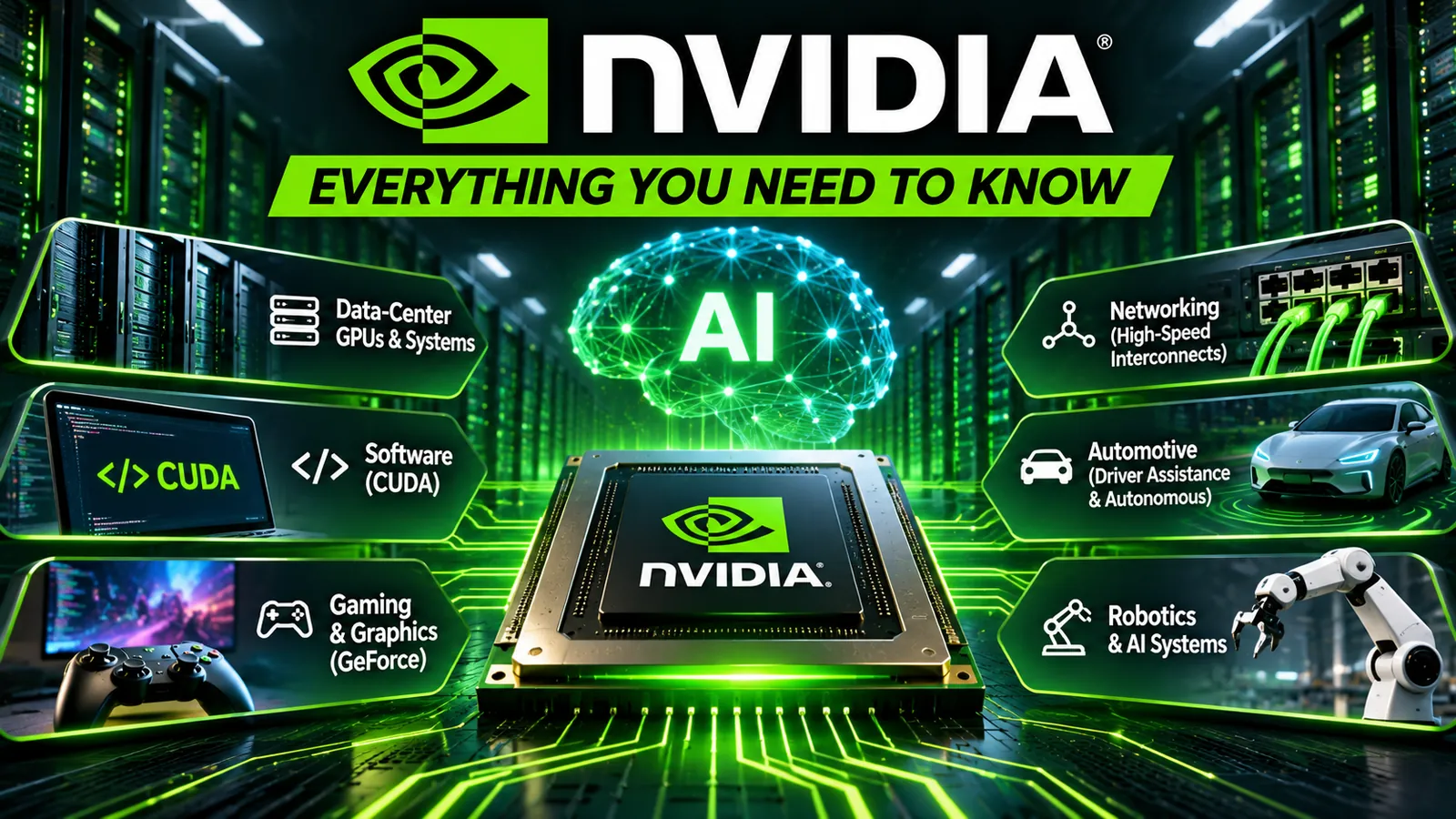
Few companies shape the technology world as much as Nvidia right now. Its chips sit inside the data centers that train and run artificial intelligence (AI) systems, and its results are watched closely by investors, governments and rival chipmakers alike.
This week the story got even bigger. Nvidia reported another record quarter on November 17, 2026, only days after its co-founder Jensen Huang stepped down as chief executive. Here is a plain-language guide to what Nvidia does, how it got here, where it stands today, and what could happen next.
From video games to the center of AI
Nvidia was founded in 1993 and has been led for most of its life by Jensen Huang, who stayed in the top job for about 33 years. The company started by making graphics chips, the parts that draw the pictures in video games. Those chips, called GPUs (graphics processing units), are very good at doing thousands of small calculations at the same time.
That ability turned out to matter far beyond gaming. Training an AI model means running a huge number of simple math operations in parallel, which is exactly what a GPU does well. Nvidia also built a software platform called CUDA that lets programmers use its chips for general computing. Over the years, millions of developers learned CUDA, and that gave Nvidia a lasting advantage: even when a rival chip looks good on paper, much of the world's AI software is already written to run on Nvidia hardware.
The result is a remarkable growth story. According to figures reported this week, Nvidia's annual revenue rose from about $4.1 billion in fiscal 2014 to about $215.9 billion in fiscal 2026. Its fiscal year differs from the calendar year, so fiscal 2027 runs from early 2026 into early 2027.
What Nvidia actually sells
People often call Nvidia a chip company, but it now sells much more than chips. Think of it as a company that builds the whole machine room for AI.
- Data-center GPUs and systems. These are the powerful processors, grouped into large racks, that train and run AI models. Nvidia releases new generations regularly, with Blackwell being the current well-known family and Rubin the next one the company has talked about.
- Networking. Thousands of chips must talk to each other quickly, so Nvidia also sells the cables, switches and connections that link them together.
- Software. CUDA and a growing set of tools help customers build and run AI applications on Nvidia hardware.
- Gaming and graphics. The original business still exists, with GeForce graphics cards for PCs and chips for workstations.
- Cars and robots. Nvidia supplies computing platforms for driver-assistance systems and is pushing into robotics, which it sees as a future growth area.
The latest results: another record
Nvidia's third quarter of fiscal 2027 ended on October 25, 2026, and the company published results on November 17. According to its official release, revenue came in at $115.8 billion. That is up 20 percent from the previous quarter and up 103 percent from a year earlier.
The data-center business is the engine. It brought in $107.6 billion in the quarter, up 21 percent from the last quarter and 110 percent from a year ago. Gross margin, which shows how much of each sales dollar is left after the direct costs of making the product, was about 74.9 percent on the company's adjusted measure.
For the next quarter, Nvidia forecast revenue of about $130 billion, give or take 3 percent, with gross margin of roughly 71 to 72 percent. That quarter includes an extra week. Importantly, the company said its forecast assumes no data-center sales to China.
| Key fact | Detail |
|---|---|
| Founded | 1993 |
| Former CEO | Jensen Huang, co-founder, stepped down November 12, 2026 |
| Interim CEO | Colette Kress, CFO since 2013 |
| Fiscal Q3 2027 revenue | $115.8 billion (quarter ended October 25, 2026) |
| Data-center revenue | $107.6 billion, up 110 percent from a year earlier |
| Next-quarter forecast | About $130 billion, plus or minus 3 percent |
| Market value | Below $4 trillion in mid-November 2026 (approximate) |
| Core products | GPUs, networking, CUDA software, automotive and robotics platforms |
A sudden change at the top
On November 12, 2026, Jensen Huang resigned as CEO and left the board. Nvidia did not give a reason in its announcement, but the move followed several days of scrutiny. The New York Times reported that he had an affair with a senior colleague, and Reuters reported that the board was weighing his removal over an alleged relationship. According to Al Jazeera, Huang acknowledged being unfaithful to his wife. There were also questions about possible national-security links involving a woman he had been seeing, reported to be a former executive at Singapore-based Megaspeed International. One analyst said there is no established evidence that he knowingly helped Beijing. The board said it had no reason to believe national security or trade secrets were compromised, and it opened an independent investigation. US lawmakers want answers: Huang has agreed to speak with House committees on December 1, according to reports. These matters are still developing, so readers should treat details as unconfirmed until the investigation reports back.
Chief financial officer Colette Kress, who has been with Nvidia since 2013, became interim CEO. Harvey Jones, a board member since 1993, was named the company's first board chair. The board is looking for a permanent CEO and is said to be considering both inside and outside candidates. At the earnings call, the company's message to investors was that the business is on track, and reports said the board is not planning to bring Huang back.
Nvidia shares dropped sharply on the news, at one point falling more than 14 percent on the day, before recovering part of the loss. Leadership uncertainty is now one of the biggest questions over the company.
Nvidia's market value, stock and profit
Nvidia is among the most valuable companies in the world. Market value moves every day, but reports on November 13 put it below $4 trillion, after a sharp pullback from its autumn high. In the latest quarter, profit was $2.70 per share, above the $2.48 that analysts had expected, which shows how unusually profitable the business is for a hardware maker.
Its customers are mostly the giants of cloud computing and AI: companies such as Microsoft, Amazon, Google and Meta, along with AI labs and a growing group of smaller cloud providers. Some of those same customers are also developing their own chips, which brings us to the competition.
Who competes with Nvidia
Nvidia has many challengers, but none has yet matched its mix of hardware, software and networking.
- AMD. The closest traditional rival in data-center GPUs, with its own AI accelerator line.
- Intel. A long-time chip leader trying to find a stronger place in AI.
- Custom chips from cloud giants. Google's TPUs and chips from Amazon, Microsoft and Meta are designed for their own workloads. Customers like them because they can lower cost and reduce dependence on one supplier.
- Chinese makers such as Huawei. Cut off from top US chips, Chinese companies are working hard on domestic alternatives.
Export rules and China
The United States restricts sales of the most advanced AI chips to China, and these rules have changed several times. Nvidia has had to redesign products, wait for licenses and, at times, write off inventory. Its latest outlook assumes zero data-center compute revenue from China, so any China sales that do happen would be a bonus rather than part of the plan.
The rules are also tightening elsewhere. On November 16, the US Commerce Department issued an interim rule that requires licenses for advanced chip exports to Indonesia, Malaysia, Singapore, Thailand and Brazil, and limits remote access to US computing power through data centers in other countries. The aim is partly to stop chips from being rerouted to China. US authorities are also investigating Megaspeed, the Singapore-based company linked to the Huang story, over alleged diversion of Nvidia chips to Chinese firms. Nvidia has not been shown in these reports to have broken rules, but the scrutiny itself adds uncertainty.
The main risks
Even a company growing this fast faces real risks. Here are the ones most often discussed.
- Leadership. Losing a founder who defined the company's strategy for three decades, with no permanent successor yet, is a major test.
- Customer concentration. A small number of very large buyers account for a big share of sales. If they spend less, Nvidia feels it quickly.
- Valuation and the AI spending cycle. Nvidia's value rests on the belief that AI spending will keep rising. If that slows, expectations could be hard to meet. Some analysts have already turned more cautious this month.
- Big commitments. Reports say Nvidia has taken on large purchase commitments to secure supply and has made deals that support smaller cloud customers. These can pay off in a boom and hurt in a slowdown.
- Supply chain. Advanced chips depend on a few specialist factories and parts suppliers, mostly in Asia, so disruptions can be costly.
- Regulation and antitrust. Governments are watching how dominant Nvidia is in AI computing, along with its export compliance.
What to watch next
First, the CEO search. The choice of a permanent leader, and whether it is an insider or an outsider, will signal how much the strategy will change. Second, the results of the board's independent investigation and any action from Congress. Third, export policy: both new US licensing rules and any shift in China's stance toward buying Nvidia products. Fourth, the rollout of its next chip generation and whether customers keep placing large orders. Finally, the next quarterly report, which will show whether the $130 billion forecast is realistic.
In short, Nvidia supplies the hardware behind the AI boom, its latest numbers are enormous, and yet it faces its most uncertain moment in years.
This article is for general information only and is not financial advice. Figures were gathered from Nvidia's official release and news reports as of November 21, 2026, and may change.
Sources: NVIDIA Newsroom (third-quarter fiscal 2027 results and CEO transition announcement), Al Jazeera, The New York Times and Reuters (as reported by Al Jazeera), Yahoo Finance, and headlines from CNBC, CNN, NBC News and ABC News. Not financial advice.