
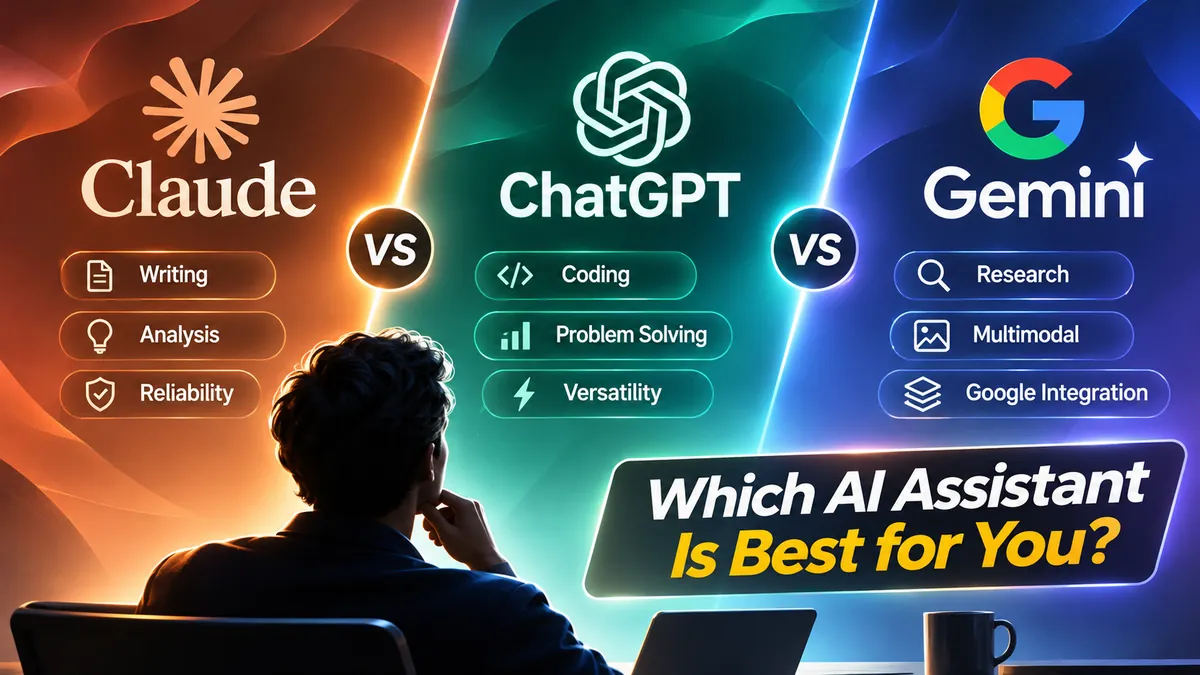
Claude vs ChatGPT vs Gemini: Which AI Assistant Is Best for You?
Claude vs ChatGPT vs Gemini compared: latest models, prices, strengths and privacy, plus which AI assistant to pick for your needs.
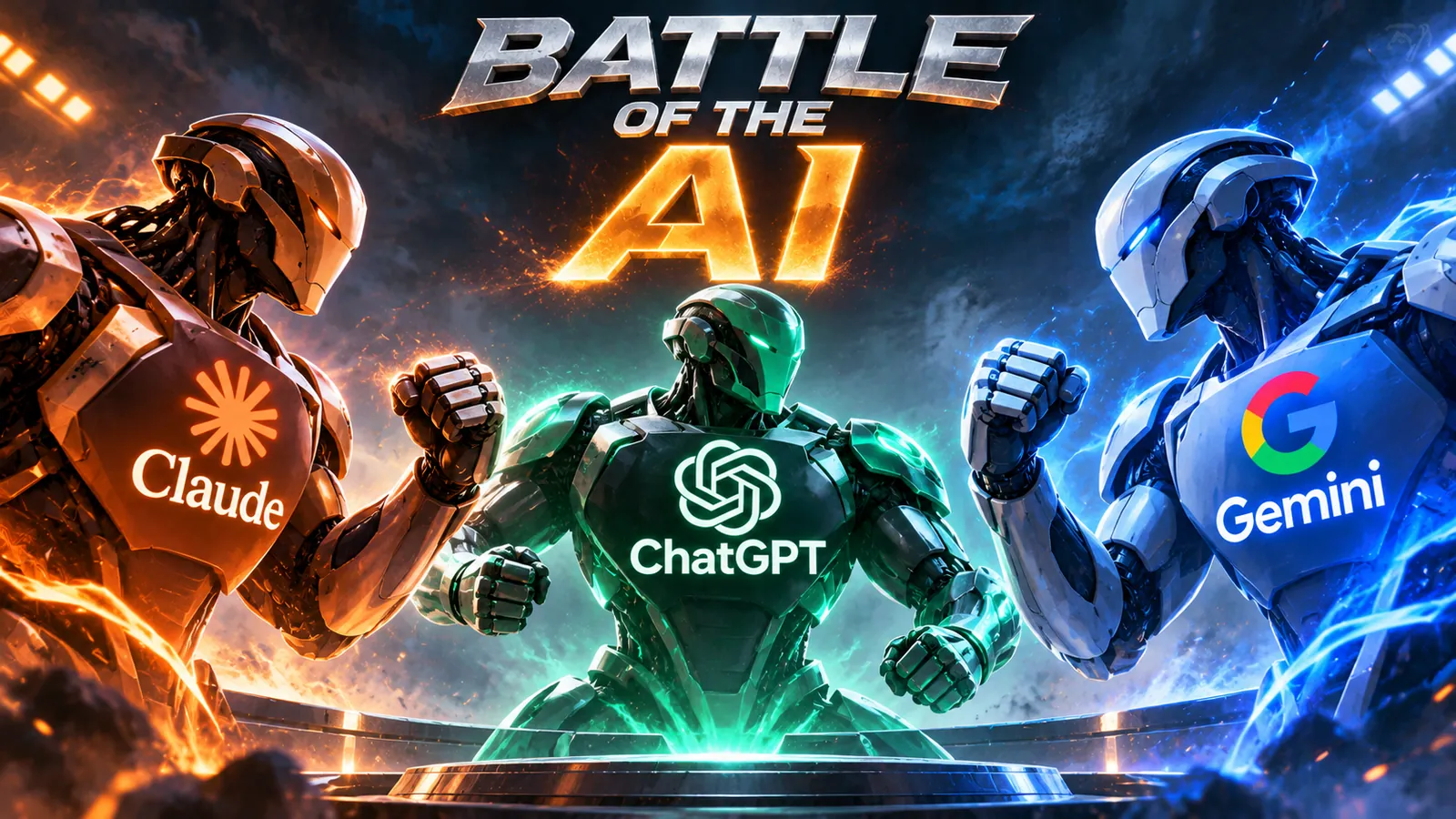
Three AI assistants dominate the conversation right now: Claude from Anthropic, ChatGPT from OpenAI, and Gemini from Google. All three have had major updates in the past few weeks, and the plans and prices have shifted again. If you are trying to decide where to spend your money, or which free tool to open first, the choice is harder than it looks.
This guide explains where each assistant stands as of November 20, 2026, what you pay, what each one tends to do well, and who should pick which. The honest answer is that no single assistant wins every task, and results change with the kind of work you give them. The purpose and the use case matter the most.
The AI assistant positions today
OpenAI announced GPT-6.2 Astra and GPT-6.2 Sol on November 17, 2026. Astra is aimed at complex professional work, and Sol is the everyday model. Both are open to ChatGPT Plus and Pro subscribers, plus Enterprise and Edu users, and both are available to developers through the API.
Anthropic released Claude Fable 5.2 on November 9, 2026. Fable is its top public model for demanding reasoning and long, multi-step jobs. Anthropic suggests that most people start with Claude Opus 5.5, which arrived on September 22, 2026 and is cheaper and faster. Smaller models, Sonnet 5.5 and Haiku 5.5, fill out the family. Anthropic also has a more restricted line called Mythos that is limited to verified organizations, so most readers will not see it.
Google has the newest launch. Gemini 4 Hydrogen arrived on November 12, 2026, and Google calls it its daily driver for fast, everyday tasks. It sits beside two larger models, Gemini 4 Argon and Gemini 4 Carbon. Carbon launched on October 28, about two weeks after Argon. Google describes both as built for deep, long-running reasoning, and early access to Carbon went first to security teams.
What you pay
All three offer a free tier, and all three have entry, mid-range and pro paid plans. The big differences show up at the top end and in what the free tier includes.
A quick note on accuracy: prices and limits for these services change often, and the figures below come from each company's pricing pages and recent coverage. Check the live pricing page before you buy.
| Claude | ChatGPT | Gemini | |
|---|---|---|---|
| Free tier | Yes. Sonnet and Haiku models, with usage limits that reset every 5 hours and weekly | Yes. Limited access to newer models, and ads may appear | Yes. A lighter Flash-Lite model, with Hydrogen chosen automatically for some prompts |
| Entry paid plan | Not offered | Go, $8 per month, with ads | AI Plus, $4.99 per month |
| Main paid plan | Pro, $20 per month ($17 per month if billed yearly) | Plus, $20 per month | AI Pro, $19.99 per month |
| Higher tiers | Max, from $100 per month | Pro, listed at $100 and $200 earlier this year | AI Ultra, $99.99 or $199.99 per month |
| Newest top models | Fable 5.2, Opus 5.5 | GPT-6.2 Astra, GPT-6.2 Sol | Gemini 4 Argon, Carbon, Hydrogen |
| Bundled extras | Claude Code, Projects, Claude in Chrome (Pro) | Codex, scheduled tasks, custom GPTs (Plus) | Storage (400 GB on Plus, 5 TB on Pro), YouTube Premium Lite on Pro |
Two details are worth knowing. On Claude, the Fable model is available on Pro only through usage credits or a share of your weekly limit, so your access depends on the plan and on recent promotions. On ChatGPT, the Go and Free tiers can show ads, while Plus does not. Gemini's Plus and Pro plans also bundle Google storage, which can make them a better deal if you already pay for extra space.
Strengths and weak spots
Benchmarks help, but they are mostly published by the companies themselves, and they shift with every release. Treat any claim of a clear winner with caution. What follows is based on how each company positions its product and on what reviewers have repeatedly noted, not on a single scoreboard.
- Claude - Anthropic puts a lot of weight on coding, long tasks and clear writing. Its newest models are described as more direct and easier to read, and Claude Code is a popular tool for developers. Its model lineup supports very large inputs of up to one million tokens in the API. On the downside, the free tier is more limited, and the strongest models can eat through usage limits quickly.
- ChatGPT - ChatGPT has the widest set of consumer features: custom GPTs, scheduled tasks, deep research, image creation, voice and a coding agent called Codex. OpenAI says Astra is trained to produce slides, spreadsheets and documents that follow professional formats. Its weak spots are a crowded model menu that can confuse newcomers, and ads on the cheaper tiers.
- Gemini - Gemini's edge is its link to Google's own world. It can pull context from Gmail and Drive, it powers Google Search answers, and it is coming to Sheets for Pro and Ultra subscribers first. Google also says Hydrogen is quick and handles PDFs, spreadsheets and video well. Its own published results show Hydrogen trailing some rivals slightly on science, math and computer-use tests, so the strongest reasoning work may call for Argon or Carbon on a higher plan.
All three companies say their newest models make fewer unsupported claims than earlier ones. None of them is free of mistakes. Whatever you use, double-check numbers, quotes and legal or medical details before you rely on them.
Privacy, memory and trust
Each assistant now has some form of memory, which lets it recall your preferences between chats. That is handy, but it also means more of your information is stored. All three services give you settings to manage memory and to control how your chats are used to improve their models, and the rules differ between personal and business accounts.
Our advice is simple. Read the privacy settings on whichever service you pick, turn off what you do not want, and keep passwords, financial details and private client data out of consumer chats. If you use an assistant at work, ask your employer which plan is approved, since business plans usually come with stricter data controls.
Pick by use case
Here is a practical guide. Think of it as a starting point, then test the free tier of your top two choices on a real task before paying.
- Writing and editing - Claude and ChatGPT are both strong, and many people choose based on tone. Try the same draft in each and keep the one that sounds more like you.
- Coding - All three have coding tools. Claude Code, Codex and Gemini's Antigravity are the main options. Developers often pick based on which fits their workflow and limits, so try each on your own project.
- Everyday questions and search - Gemini is a natural fit if you live in Google Search. ChatGPT is a strong all-rounder for general questions.
- Work inside Gmail, Docs and Drive- Gemini has the tightest link to Google Workspace. Claude also offers a Microsoft 365 connection on Pro for people who work there.
- Reports, slides and spreadsheets - ChatGPT's new Astra model is built for this kind of output. Claude and Gemini also handle documents and data, so compare results on your own files.
- Research and long documents - All three offer research modes and handle long files. Claude's models list a one million token window in the API, and Google has talked up very large context too. Test with your longest file.
- Images, video and creative play- Gemini's plans include video generation and Flow credits, and ChatGPT includes image creation. Claude is more focused on text, code and documents.
- Tight budget- Gemini AI Plus at $4.99 and ChatGPT Go at $8 are the cheapest paid steps. Claude has no plan below Pro, though its free tier is usable for light work.
- Heavy daily use - Look at the $100 tiers on all three and compare usage limits, since this is where the plans differ the most.
Our bottom line
There is no single best assistant in November 2026. The three are close enough that your habits matter more than the brand. If you mostly use Google's apps, Gemini will feel natural. If you want the broadest toolbox in one app, ChatGPT is hard to beat. If your work is writing, long documents or coding, Claude deserves a serious look.
The practical move is to run the same three or four real tasks through all of them on free plans, note which answers you trust and enjoy using, and then pay for just one. Because new models are arriving every few weeks, avoid long prepaid plans unless the discount is big. You can switch again whenever the next release changes the picture.
Sources: Anthropic (claude.com/pricing and platform.claude.com model overview), Google (gemini.google/subscriptions and blog.google I/O 2026 plans post), OpenAI (chatgpt.com/pricing), SiliconANGLE (Nov 17, 2026), 9to5Mac (Nov 9, 2026), TechCrunch (Sept 22, 2026), Digital Trends (Nov 12, 2026), Constellation Research, TechRadar, Animalz.
Newsfactory articles are written for general information and are not financial, legal or investment advice. See our disclaimer and editorial policy.