

Israel's Election Ends Without a Clear Winner: What Happens Next
With 97% of ballots counted, Netanyahu's bloc leads with 53 seats to Eisenkot's 48, but neither has 61. Here is what could happen next.
Israel's election has produced a political cliffhanger. With 97% of ballots counted, Prime Minister Benjamin Netanyahu's Likud party and its allies are on track for 53 seats in the 120-seat Knesset, while the bloc led by former military chief Gadi Eisenkot is set for 48. Neither side has the 61 seats needed to govern. Turnout was 77.7%, the highest in more than two decades, and both men say they will try to form the next government.
Here is what the count shows, why the numbers could still shift, and how Israel's system could turn a stalemate into a new government, or into another election.
A Race Too Close to Call
When voting ended, three Israeli broadcasters projected that Eisenkot's "Change Bloc" would win 52 or 53 seats, against 50 for Netanyahu's side. Updated projections later showed two of them with the blocs level at 51 seats each, and the third giving Netanyahu a narrow three-seat lead. The real count then went Netanyahu's way, and his bloc did better than the exit polls had predicted.
Even so, 53 seats is 15 fewer than his bloc held in the last Knesset, so Netanyahu is ahead but weakened. The Arab-led parties, which belong to neither camp, are on course for an unprecedented 19 seats.
The picture could still change. On Thursday, officials began counting as many as 480,000 absentee ballots from soldiers, diplomats, hospital patients and others who could not reach a polling station. Under Israel's proportional system, these votes may shift a seat or two between parties. The official results are due on November 4.
Who Are the Players?
Netanyahu's bloc is built around Likud, the biggest single party, which is on course for 27 seats. Its partners are the ultra-Orthodox parties United Torah Judaism (7 seats) and Shas (6), the hard-right Jewish Power party, also known as Otzma Yehudit (7), and Religious Zionism (6). Together, that makes 53.
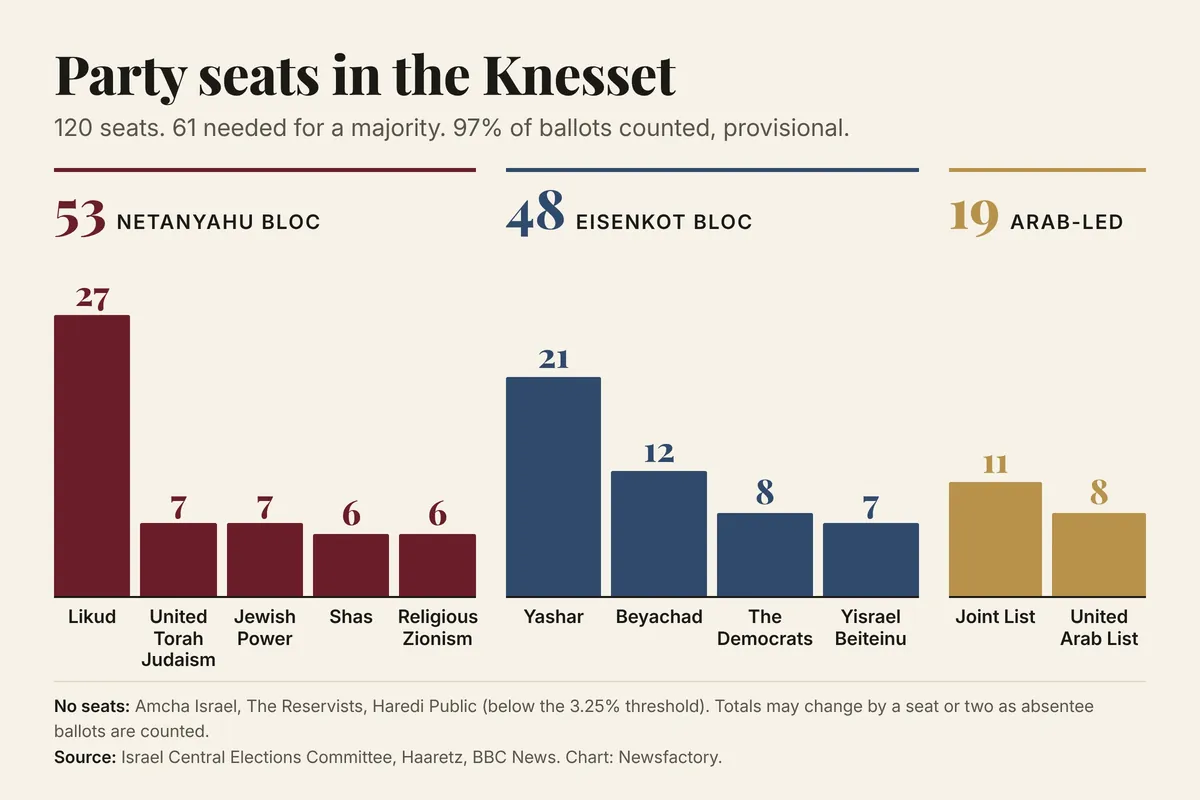
Eisenkot's new party, Yashar, leads the other side with 21 seats. Beyachad, linked to former prime minister Naftali Bennett, has 12, The Democrats have 8 and Yisrael Beiteinu has 7, making 48. Several small parties, including the Reservists and the Haredi Public list, fell short of the 3.25% vote share needed to enter parliament and won no seats.
The two Arab-led parties, the Joint List (11 seats) and the United Arab List, also called Ra'am (8), are set to almost double their combined representation. The reason is a surge in turnout among Arab citizens, who make up about a fifth of Israel's population.
The Arab Parties: Kingmakers or Outsiders?
On paper, 19 seats could make them kingmakers. In practice, all but one of the Jewish parties have pledged not to work with them. Netanyahu has said it is "forbidden" to form a government that relies on what he calls anti-Zionist Arab parties. Eisenkot has set conditions in the past, including recognition of Israel as a Jewish and democratic state, and the right-wing parties in his bloc reject the idea outright. Others are more open. Democrats leader Yair Golan sees an opportunity to form a "change government in partnership" with the Arab parties, and Ra'am leader Mansour Abbas hopes the numbers add up to 61 with the Change Bloc. Joint List leader Yousef Jabareen says the opposition cannot dictate terms and will have to negotiate if it wants real change. He also said Arab voters were motivated partly by the chance to remove the far-right national security minister, Itamar Ben-Gvir, from office.
How Israel Forms a Government
Israel's system does not hand power to the biggest party automatically. Here is the process in simple steps.
- Final results: Once the count is certified, the election committee publishes the official seat totals. President Herzog expects them next week.
- Presidential consultations: President Isaac Herzog meets with leaders of every party that won seats and asks whom they recommend. He then picks the lawmaker he believes has the best chance of putting together a majority. That person is not necessarily the head of the largest party. Herzog has urged everyone to come with an open mind and do all they can to avoid another election.
- The coalition window: The chosen candidate has 28 days to build a government, with a possible 14-day extension, so up to 42 days in all.
- Confidence vote: The new government needs a simple majority in the Knesset to take office. If some parties abstain, the government may not need a full 61 votes.
- Plan B: If the first candidate fails, the president can give the task to someone else for another 28 days. After that, the Knesset itself can back a candidate, who would get 14 days. If every attempt fails, parliament dissolves and a new election must be held within 90 days, with Netanyahu's government staying on as a caretaker.
There are several possible outcomes. A narrow 61-seat coalition could emerge once the final numbers settle. A minority government might survive if other parties abstain. Or the two big camps could try a power-sharing deal in which the premiership rotates. Each is possible, but each comes with big obstacles.
Allegations Against the Arab Parties
Likud has accused the Arab parties of "stealing" the election. It told the Central Elections Committee that they had used bribery, threats, violence, fraud and prohibited software to encourage voters, but it offered no evidence. The committee said it would look into the claims as part of a full post-election review, and its director has said that claims of widespread fraud appear to be baseless.
On Thursday, the committee's chairman, Justice Noam Sohlberg, asked the Shin Bet security service to investigate what he called serious suspicions of improper influence through foreign funding. He gave no details. The newspaper Haaretz cited a source saying the committee had been told that Qatar had funded efforts to raise turnout in Arab communities. Qatar's foreign ministry spokesman called the accusation "ridiculous and dangerous," and the Joint List's Sami Abu Shehadeh dismissed it as a racist smear. No evidence for either claim has been made public so far.
What the Leaders Are Saying
Eisenkot told supporters that the public had "spoken in favour of change" and that the "coalition of failure" had lost people's trust. He promised to work toward a Zionist government. Netanyahu, speaking at Likud headquarters, declared that his right-wing bloc had won a "great majority" and called for a strong national government. Both men insist they should be given the first chance to form it. Herzog praised the high turnout as a "badge of honour" for Israeli society.
Analysts make a balanced point: Netanyahu appears to have lost the comfortable majority he had, but his rivals face an equally hard job reaching 61. That means he could stay on as caretaker prime minister for weeks or longer while negotiations drag on. If every attempt to form a government fails, Israel would face another election.
Why This Matters Beyond Israel
This was the first election since the Hamas-led attacks of 7 October 2023 and the wars that followed in Gaza, Lebanon and Iran, and many Israelis saw it as one of the most consequential in the country's history. Key issues included accountability for the security failures behind the attacks, the conduct of the wars, drafting ultra-Orthodox men into the army, judicial reforms and Israel's standing abroad. A slow-forming government can make big decisions harder, from security policy to diplomacy with Washington, and political uncertainty can affect markets and the shekel.
The Bottom Line
The votes are in, but the real contest is only starting. Over the coming days, the remaining absentee ballots will be counted, the official seat totals will be published, and President Herzog will begin the delicate task of choosing who gets the first chance to form a government. The figures in this article come from the count reported on October 29, with 97% of ballots counted, and they may change by a seat or two. We will keep following the story as the official results arrive.
Sources consulted
- Al Jazeera: Netanyahu or Eisenkot, can you form Israel's next coalition government?
- Al Jazeera: Five key takeaways from Israel's parliamentary elections
- Al Jazeera: Israel's election, what the candidates said and how they did
- Times of Israel: With 90% of votes counted, Netanyahu bloc has 53 seats, Eisenkot's 48; Arab parties surge to 19
- Times of Israel liveblog, October 29, 2026
- BBC News: Israel election results and coalition talks
Newsfactory articles are written for general information and are not financial, legal or investment advice. See our disclaimer and editorial policy.