
Eisenkot vs Netanyahu: Who Will Lead Israel Next?
Eisenkot has been tasked with forming Israel's government. Here is where the coalition race against Netanyahu stands and what could happen by December.
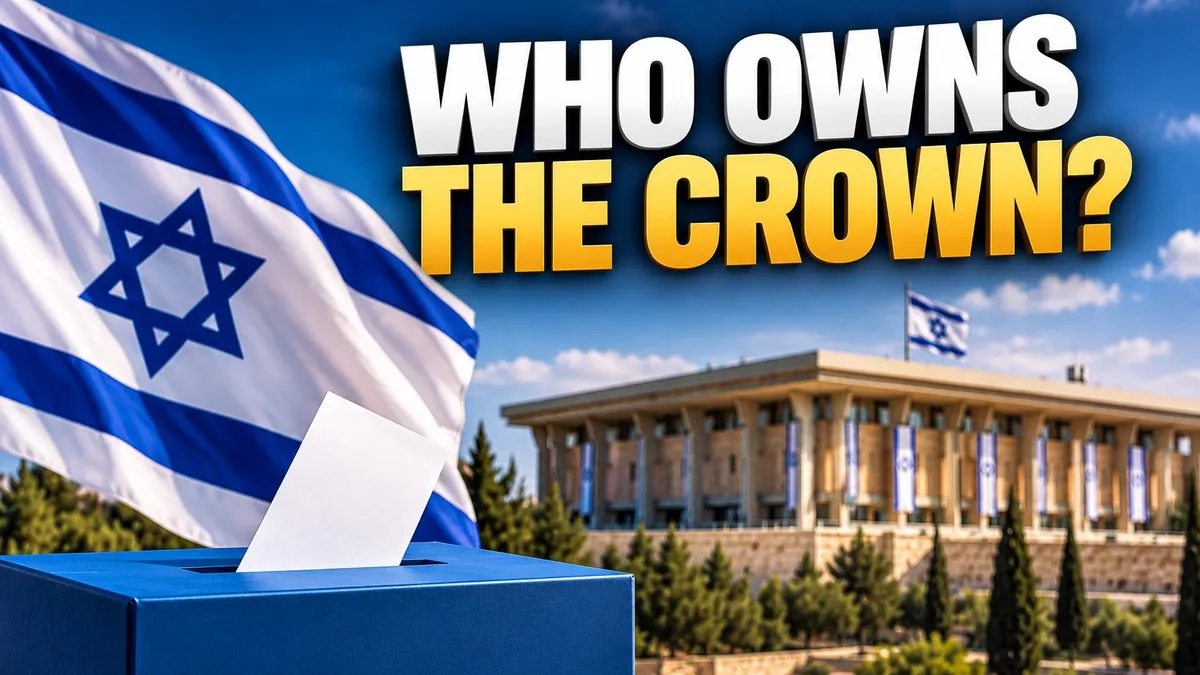
Two weeks after Israelis voted, the picture is clearer but the outcome is not. The official results are in, the 26th Knesset has been sworn in, and President Isaac Herzog has asked former military chief Gadi Eisenkot to try to form the next government. Benjamin Netanyahu, whose bloc won the most seats, remains prime minister in a caretaker role. Neither Eisenkot nor Netanyahu has the 61 seats needed to govern, and the clock is now running.
This article updates our earlier report from election week. Here is what the final numbers show, what has happened since, and the paths that could lead to a government or a new election.
The Final Numbers
The Central Elections Committee published the final results on October 30. Turnout reached 77.9%, with about 5.7 million votes cast. The seat totals matched the count we reported last time, so the late absentee ballots did not change the picture.
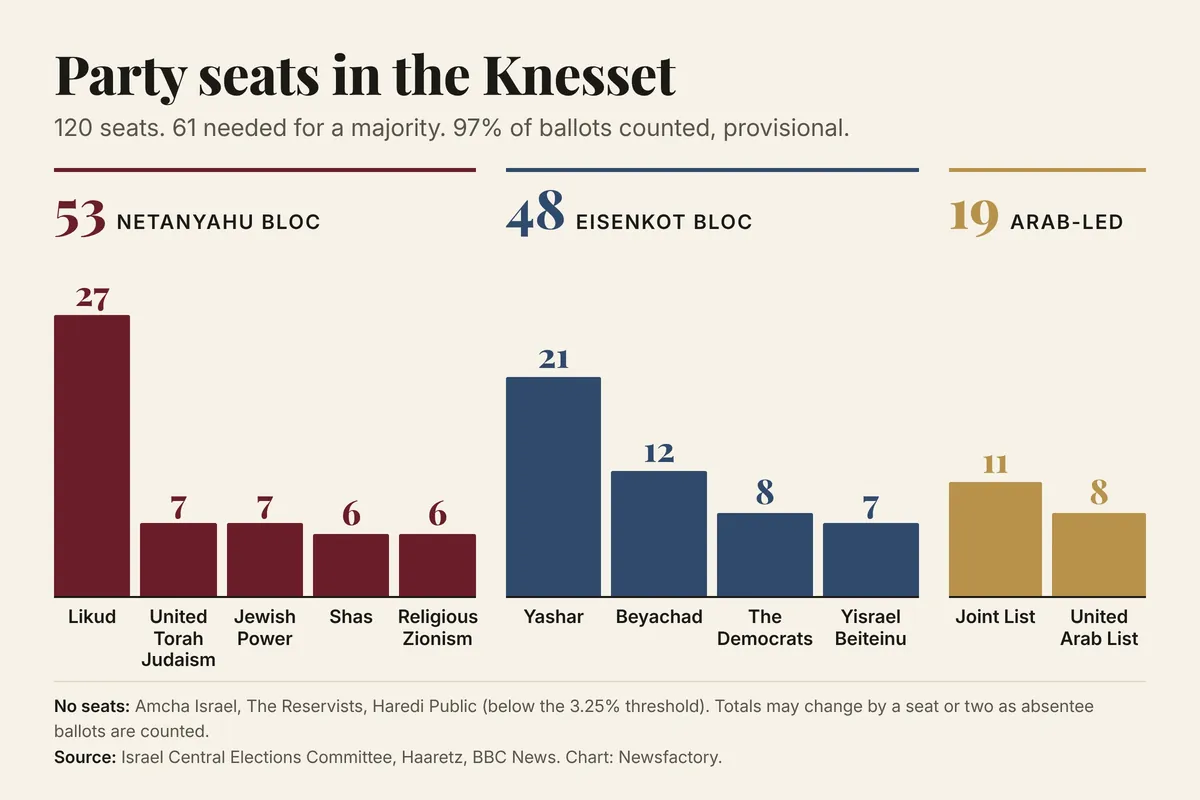
Netanyahu's bloc finished with 53 seats. Likud is the largest party with 27, joined by United Torah Judaism (7), Otzma Yehudit, also known as Jewish Power (7), Shas (6) and Religious Zionism (6). Eisenkot's side won 48: his new Yashar party took 21, Beyachad 12, The Democrats 8 and Yisrael Beytenu 7. The Arab-led parties, the Joint List (11) and Ra'am (8), won a record 19 seats between them and belong to neither camp.
The Knesset has 120 seats, so a majority is 61. Netanyahu is eight short. Eisenkot is thirteen short on his own bloc's numbers. That gap is the whole story.
Why Eisenkot Was Chosen First
In Israel, the president does not simply hand the job to the leader of the biggest party. Herzog consults every party that won seats, then picks the lawmaker he believes has the best chance of building a majority. On Sunday, November 8, he chose Eisenkot, even though Netanyahu's bloc is larger. The Arab-led parties, which also oppose Netanyahu, are part of the reason: together with Eisenkot's bloc they outnumber Netanyahu's side.
Eisenkot has up to six weeks. His deadline is December 6, and it can be extended by two weeks to December 20. He has been honest that the task is hard, calling his path "extraordinarily complex."
The New Parliament Begins
The Knesset was sworn in on Tuesday, November 10, still without a government. Within hours, lawmakers allied with Eisenkot filed bills that show what a government under him would try to do: set up a state inquiry into the October 7, 2023 Hamas attacks, introduce term limits for the prime minister, and undo the judicial changes passed under the outgoing government. It is unclear how quickly any of these will move.
There is also a fight over the speaker's chair. Opposition parties have collected signatures to remove Amir Ohana, a Netanyahu ally, and have nominated Matan Kahana of Yashar to replace him. A vote can happen even before a coalition exists, which makes it an early test of whether Eisenkot's side can hold together.
Three Roads, Each With a Roadblock
Eisenkot has three realistic options, and none is easy.
- A minority government. He could lead a minority government that relies on the Arab parties' 19 seats, either by having them vote with him or simply not vote against him. The Arab parties back an inquiry into October 7, which Netanyahu opposes. But Eisenkot has said any cooperation depends on them accepting Israel as a Jewish state and calling Hamas a terrorist group, and some right-leaning parties in his own camp reject the idea outright.
- A deal with the ultra-Orthodox parties. Bringing in the ultra-Orthodox parties would give him a majority on paper. But they have said they will not join a government led by him, and the two sides have clashed for years, especially over drafting ultra-Orthodox men into the army.
- A unity government with Likud. Netanyahu has called on Jewish-led parties to form a national unity government, pointing to the threat from Iran. Eisenkot rejected the tone of that appeal as divisive and cancelled a planned meeting with Likud. A unity deal would also force a hard question: who leads it, and does Netanyahu, who is on trial for corruption, stay?
Netanyahu's Position
Netanyahu stays in office as caretaker prime minister until a new government wins the Knesset's confidence. Courts have set limits on what he can do, but he keeps full authority over national security, including the military, and can still make appointments. He also faces an ongoing corruption trial and possible findings about the security failures that came before October 7.
Since the vote he has claimed that Arab-led parties "stole" the election. Election officials say they are looking into possible misconduct, but they have seen no evidence that fraud changed the result. Arab citizens make up about a fifth of Israel's population, and the higher turnout among them is the main reason their parties gained seats.
What Happens If Eisenkot Fails?
The law lays out a clear ladder. If Eisenkot cannot form a government by his deadline, Herzog is expected to give Netanyahu the next chance. If Netanyahu also fails, another lawmaker can be tried. If every attempt fails, Israel goes back to the polls. Herzog has urged politicians to do everything they can to avoid that, but the numbers make it a real possibility. Analysts also warn that a stalemate could leave this parliament with a very short life.
Why It Matters Beyond Israel
A government decides how Israel handles the war aftermath, relations with Washington, its stance toward Iran and the future of Gaza. Until one exists, big decisions are harder and a caretaker leader holds the reins. Political uncertainty can also affect the shekel and Israeli markets, and allies are watching closely to see whose policies they will be dealing with in 2027.
The Bottom Line
Israel has a new parliament, a designated candidate and a deadline, but still no government. Eisenkot has until December 6, possibly December 20, to find 61 votes or a workable alternative. The next few weeks will show whether the parties choose a deal, a unity compromise, or another election. The figures here are based on reports published up to November 13, 2026, and we will update this story as the talks develop.
Newsfactory articles are written for general information and are not financial, legal or investment advice. See our disclaimer and editorial policy.