

Iran vs US-Israel War: Latest Update, Key Facts, and What Could Come in 2027
Where the Iran vs US-Israel war stands today, the Hormuz blockade, stalled talks, oil and shipping costs, US politics and what 2027 could bring.
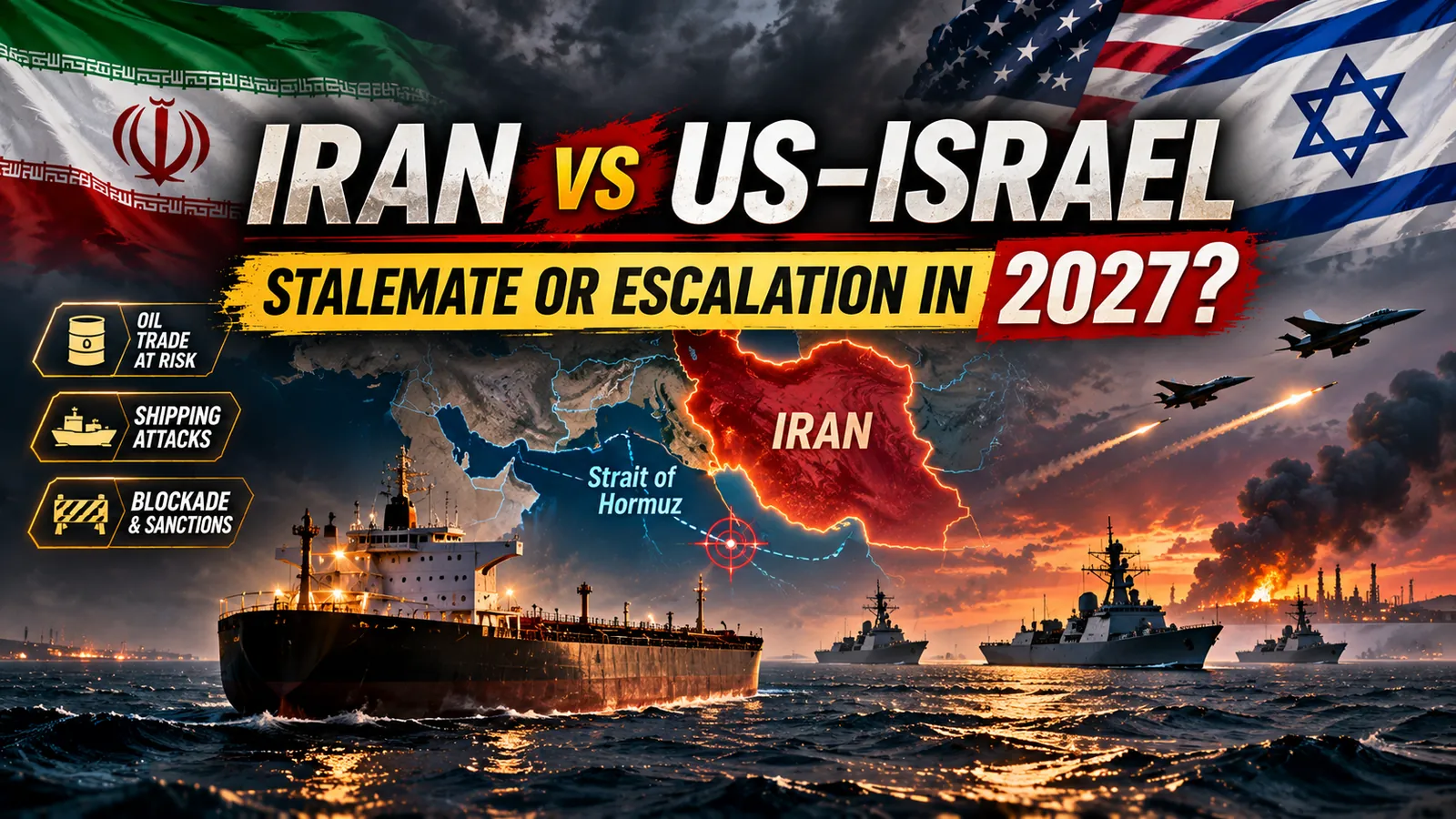
The war between Iran and the United States and Israel has settled into a tense, dangerous stalemate. Big air campaigns have mostly stopped, but ships are being attacked in and around the Gulf, Iran and the US keep trading limited strikes, and talks to end the war have not produced a deal. Here is where things stand as of reports up to November 22, 2026, and why the world economy is paying attention.
Things you should know
- How it started: The US and Israel launched the war on Iran on February 28, 2026, beginning with a fast air campaign. President Trump has said the number one goal is that Iran can never have a nuclear weapon.
- A blockade is the main weapon now: Iran has essentially closed the Strait of Hormuz, warning that ships without its permission could be targeted. The US put a naval blockade on Iranian ports in April. An interim deal in June paused the fighting and lifted the blockade, but the deal fell apart in July as fighting over the strait grew, and the blockade returned on July 14.
- Attacks continue from both sides: Iran’s Revolutionary Guards say they hit radars at US bases in Bahrain, and Bahrain reports a fire at a civilian industrial site in Sitra on November 21. The US has struck targets such as Qeshm Island.
- Shipping is under fire: Tankers have been hit in and around the Strait of Hormuz in recent days. The International Maritime Organization (IMO) has confirmed at least 130 incidents involving commercial vessels since the war began, with at least 25 seafarers killed, according to its figures from early November.
- Talks are stuck: A Qatari delegation held about two hours of talks in Tehran on Friday night, November 20, Iran’s deputy foreign minister said. Iran says these are not yet formal negotiations. Iran’s conditions include lifting the blockade and sanctions, releasing frozen funds, and ending the war on all fronts.
- Trump’s position: President Trump says he wants “a deal that can be lasting” and that Iran cannot have a nuclear weapon. Marco Rubio has said Iran’s demands are not acceptable to Washington.
- US politics matters: Republicans lost control of Congress in the November 3 midterms, and Democrats take over in January 2027. On November 19, the Senate rejected a war powers resolution 51 to 48. Congress also faces a December 11 funding deadline, and some Democratic senators want the next funding bill to limit spending on the Iran war.
- The human cost: Reports say the war has killed thousands of people, but we found no reliable exact total, so we do not give a death toll.
Latest update
On November 18, US Central Command warned that any ship taking cargo from a blockaded tanker at sea may be treated as evading the blockade and could be stopped, boarded, or captured. The US says its blockade has stopped Iran from loading crude since late August, though that is a US claim. Iran says the strait is closed to unauthorized ships, and its navy says ships must follow Iran-set lanes.
Iran says it shot down US drones over the Strait of Hormuz. That claim has not been independently verified. On the US side, the Treasury sanctioned four Iranians it calls “oil trustees.”
Impact on global trade
Before the war, the Strait of Hormuz carried about a fifth of the world’s oil and roughly a fifth of its liquefied natural gas, with more than 130 ship crossings a day. The shipping monitor UKMTO counted 263 ships crossing from November 12 to 18.
Oil has been volatile. Brent was around $72 a barrel before the war, climbed to $117 in late October, and was about $92 in mid-November, according to Al Jazeera.
- Insurance: Marsh, the insurance broker, said on July 22 that war-risk extra premiums for Hormuz had risen from 1–3 percent of a ship’s hull value to 7.5–10 percent. OPEC data show that insurance for a Middle East-to-East Asia tanker cargo rose about 200-fold between January and the end of October, to $12.29 per barrel.
- Fuel prices: US gasoline averaged $3.80 a gallon, against $2.98 before the war, while diesel was about $5.93, against $3.72.
- Supply losses: The International Energy Agency says the war has caused cumulative supply losses of 2.8 billion barrels of oil and 60 billion cubic meters of gas from the Gulf.
- Iran’s economy: Iran’s official statistics show its economy shrank 10.1 percent year on year from late March to late June, with oil and gas activity down 26.4 percent.
Impact on geopolitics
The conflict has pulled in the Gulf states, with Bahrain and Kuwait targeted by Iranian drones, and has put a heavy strain on US forces. A third US aircraft carrier, the USS Theodore Roosevelt, arrived in the Middle East on November 15, so three carrier strike groups are now in the region. It is not yet clear whether the US will keep all three there. The situation can be described as a fragile equilibrium that could tip back into full war. In the US, a Reuters/Ipsos poll found that 71 percent of Americans want the new Democratic-led Congress to pass legislation to end the conflict.
What could be expected in 2027
No source we read gives a firm forecast for 2027, so these are the signals analysts point to rather than predictions. First, the political calendar: a Congress under Democratic control from January 2027 could limit the president’s room to escalate. Second, the stalemate could continue as a “frozen conflict,” with a blockade, scattered attacks, and elevated oil and shipping costs. Analyst Hamidreza Azizi of the International Crisis Group says Iran may eventually decide that escalating is preferable to the status quo as economic pressure builds. Third, a deal is possible, since Iran says it is still talking with mediators including Qatar, but both sides remain far apart on uranium, sanctions, and the blockade.
Conclusion
This war is no longer about daily headlines of big strikes. It is a slow squeeze on oil routes, shipping, and the Iranian economy, with the risk of sudden escalation. For ordinary people, the effects show up in fuel prices, shipping costs, and overall inflation. Whether 2027 brings a deal or a longer standoff will depend on mediated talks and on the political shift in the US and Israel.
Sources consulted
- Al Jazeera: Is the US-Israel war on Iran turning into a ‘frozen conflict’? (Nov 17, 2026)
- Al Jazeera: ‘Status quo’ between US and Iran could break out into war, analysts warn (Nov 18)
- Al Jazeera: Can the US and Iran sustain a ‘frozen war’? (Nov 18)
- Al Jazeera: Kuwait, Bahrain face new Iran attacks after US strike on Qeshm Island (Nov 18)
- Al Jazeera: Iran says held talks with Qatari mediators, urges US to accept conditions (Nov 21)
- Al Jazeera: USS Roosevelt arrives in Middle East (Nov 16)
- Al Jazeera: UN says 25 seafarers killed in, around Hormuz since US-Israel war on Iran (Nov 14)
- Al Jazeera: How oil, gas losses have shrunk Iran’s GDP by 10 percent during war (Sept 21)
- Al Jazeera: US reimposes blockade on Iranian ports, launches more strikes (Jul 14)
- Reuters via US News: Qatari delegation visits Tehran for talks, Iranian official says (Nov 21)
- Reuters via gCaptain: US targets ship-to-ship transfers in expanded Iran maritime blockade (Nov 18)
- Reuters via Al-Monitor: US slaps sanctions on Indian, Turkish firms and people for aiding Iran (Nov 4)
- AP via ADN: Senate rejects resolution to block Trump from striking Iran (Nov 19)
- AP via ABC7: US restores blockade on Iran after its attacks on ships in the Strait of Hormuz (Jul 14)
- IMO via Cyprus Mail: IMO warns of growing threats to shipping as seafarer deaths reach 25 (Nov 12)
- IEA figures via Hydrocarbon Processing: IEA energy-security response to Iran war could cut oil demand by 4% by 2035
- OPEC data via Gulf News: Revealed: The hidden cost of the oil price spikes
- S&P Global: Middle East shipping insurance costs rise on Hormuz risks: Marsh (Jul 22)
- Reuters/Ipsos poll via KTVU: Latest poll finds most Americans want Congress to end Iran war (Nov 10)
- Gulf News: Iran war at crossroads: Trump demands ‘lasting’ deal
- Israel National News: President Trump Delivers Remarks, Nov. 9, 2026 (Trump and Rubio quotes)
- Al Jazeera: Iran topic page, headlines for Nov 21 (sanctions on four Iranians, Iran’s claim on US drones)
- Al Jazeera: US to send third aircraft carrier towards Iran (Oct 2)
- Congress funding deadline: Al Jazeera, US House passes funding bill to avert government shutdown (Sept 1)
Newsfactory articles are written for general information and are not financial, legal or investment advice. See our disclaimer and editorial policy.